
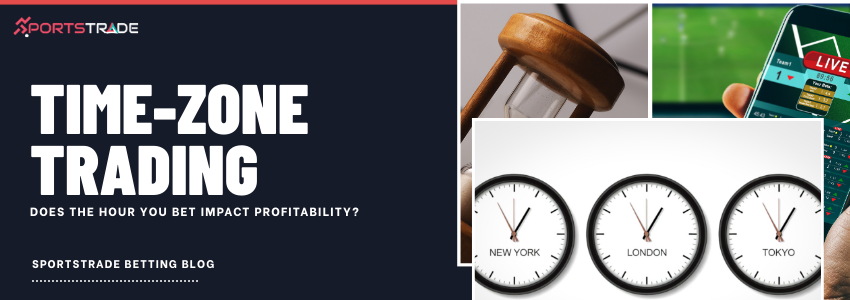
Sports trading is all about timing. But what if the actual time of day you place your trades or bets plays a bigger role in profitability than most traders realize? Welcome to the world of time-zone trading — where understanding market behavior by hour can help uncover hidden edges.
Time-zone trading refers to analyzing how market conditions, liquidity, odds movement, and bettor behavior vary depending on the time of day.
In global markets like football, tennis, or basketball, matches and market activity span multiple continents. This means:
Asian markets are active early in the day.
European markets peak in the evening.
American sports dominate late-night and overnight hours (Asia/Europe time).
Odds tend to be most efficient closer to kickoff. Betting early might offer value before sharp corrections, while late betting means less edge but more certainty.
Different regions are active at different times. For example:
European football markets often see sharp money enter in the 2-5 PM GMT window.
Late-night tennis markets (like ATP/WTA US matches) might see thinner liquidity and more pricing inefficiencies.
Your own mental state matters. Trading tired at 3 AM might lead to poor decision-making, especially in fast-moving live markets.
More value for pre-game bets before sharp money shapes the line.
Risk: more uncertainty due to lack of news or lineup info.
Many sharp bettors act here after absorbing team news, public sentiment, and price movement.
Great for finding mispriced late moves.
Niche for traders seeking inefficiencies in obscure or low-interest matches.
Requires high discipline and data knowledge.
Track Your Results by Hour: Use your trading journal to log time of day and analyze trends.
Align with Your Strengths: If you're most alert in the morning, focus on Asian or early European markets.
Avoid Emotional Late-Night Trades: Fatigue leads to chasing losses or bad reads.
Leverage Automation Tools: Set alerts or even bots to monitor key markets if you're asleep.
Time-zone trading is a forgotten layer of edge in sports markets. Most traders track stats and strategies—but few study their own patterns across time. If you can match market rhythm with your mental peak hours, you’ll sharpen both your edge and discipline.
Don’t just ask "What should I trade?" Ask, "When am I at my best?"




Copyright © 2019 SportsTrade.io and all its predictions.
We're concerned about problem gambling. For most people, gambling is entertainment - a fun activity that can be enjoyed without harmful effect. But for some, it's not just a game - it's a serious problem that continues even after the fun has gone.
Compulsive gambling is not easily detected. The person with a gambling problem will often go to great lengths to cover up the problem and will appear to look all right, regardless of the consequences of their gambling.
Warning Signs. Some of the indicators that a person may be suffering from a gambling problem include:
Losing time from work or family due to gambling.
Repeated failed attempts to stop or control gambling.
Borrowing money to gamble or pay gambling debts.
Gambling to escape worry or trouble.
Neglecting the care of one's self or family in order to gamble.
Lying about the amount of time and money spent on gambling.
Gambling more money in an attempt to win back losses.
Selling or pawning personal possessions to get money to gamble.
Feelings of hopelessness, depression, or suicide as a result of gambling.
Remember that help is available. By reaching out to people who understand, you can find the help you need. You can visit the Gambler's Anonymous website here:http://www.gamblersanonymous.org/ or Responsible Gaming Council here: http://www.responsiblegambling.org/
This is a non-profit organization not affiliated with us in any way.
It is an offence for persons under the age of eighteen (18) to make use of the Website. If we are unable to confirm that you are 18 years old then we may suspend your account until such time that we are able to confirm your age. If you are subsequently proven to have been under 18 years of age at the time you made any transactions with us, then:
Your Account will be closed.
All transactions on your account will be made void, and all related funds deposited by you will be returned by the payment method used for the deposit of such funds, wherever practicable.
Sportstrade is committed to providing the best service possible. We want our member to have confidence in our platform, and that's why we offer a Credit Back Guarantee to all tips without profits. This program comes into effect on the 01 July 2015 ('Effective Date') and is offered to ensure that member who made tips purchase of any tips that ended with either lose, draw, cancelled or postponed game. The credits will automatically refund to your account the next day and the information will be available after login in the member dashboard and available in 'transaction history' tab