
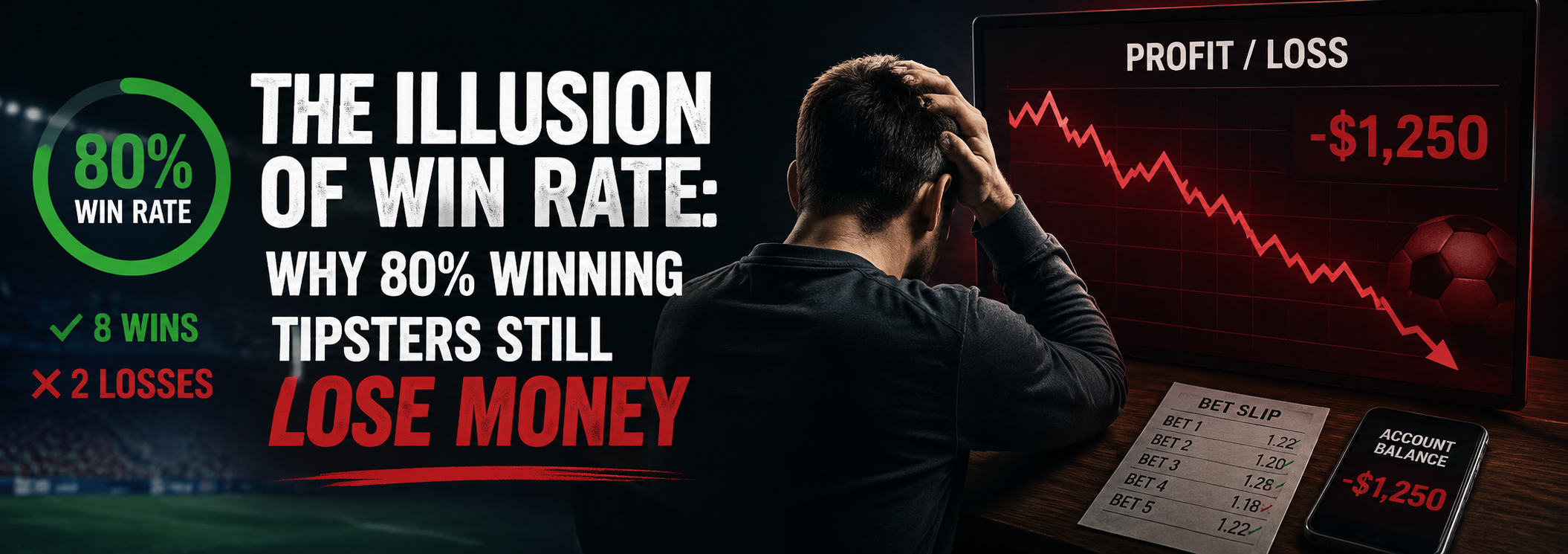
If you spend enough time in sports betting communities, you'll eventually come across a tipster boasting an incredible statistic:
"80% Win Rate."
At first glance, it sounds unbeatable. After all, if someone wins 8 out of every 10 bets, surely they must be making money, right?
Not necessarily.
In fact, one of the biggest misconceptions in sports betting is the belief that a high win rate automatically equals profitability. The truth is that many bettors become obsessed with strike rate while completely ignoring the metric that matters most:
Return on Investment (ROI).
And that's how some 80% winning tipsters still manage to lose money.
Humans naturally love certainty. A tipster posting:
8 wins from 10 bets
16 wins from 20 bets
40 wins from 50 bets
Creates a powerful psychological effect.
It feels safe.
It feels consistent.
It feels like success.
That's why many tipsters use win rate as their primary marketing tool. It's simple, easy to understand, and emotionally appealing. But betting isn't a game of counting wins. It's a game of managing value.
Imagine two tipsters.
Tipster A
Wins 80% of bets
Average odds: 1.20
Tipster B
Wins 55% of bets
Average odds: 2.10
Most bettors would instinctively choose Tipster A.
But let's look closer.
Suppose both tipsters place 100 bets with equal stakes. Tipster A wins 80 bets and loses 20.
At odds of 1.20:
Profit from wins = 80 × 0.20 = 16 units
Losses = 20 units
Overall result:
-4 units
Despite winning 80% of the time, Tipster A loses money. Meanwhile, Tipster B wins only 55 bets.
At odds of 2.10:
Profit from wins = 55 × 1.10 = 60.5 units
Losses = 45 units
Overall result:
+15.5 units
The lower win-rate tipster is significantly more profitable.
Many bettors become addicted to winning. Not profitability.
Winning.
Those aren't the same thing. High-win-rate tipsters often focus on:
Heavy favorites
Short odds
"Safe" selections
This creates a pleasant experience because followers see frequent green results. But short odds come with a hidden problem: A single loss can wipe out multiple wins.
For example:
Five bets at 1.20 odds produce:
+0.20
+0.20
+0.20
+0.20
+0.20
Total:
+1 unit
One losing bet:
-1 unit
Back to zero. The margin for error becomes incredibly small.
Professional bettors rarely ask:
"How often does this tipster win?"
Instead, they ask:
"How much value does this tipster generate?"
Expected Value (EV) measures whether the odds are better than the true probability of an event occurring. A profitable tipster can:
Lose frequently
Experience long losing streaks
Have a lower strike rate
Yet still generate strong returns because the prices they take contain value. This is the difference between betting and investing. Investors don't count winning trades. They measure profitability.
There's a reason you see "90% win rate" advertised far more often than "12% ROI." Most people don't understand ROI. Everyone understands winning.
A high strike rate sells subscriptions.
A strong ROI builds bankrolls.
Unfortunately, these are not always the same thing. That's why smart bettors look beyond marketing headlines and dig deeper into the numbers.
When evaluating a tipster, focus on:
Long-term ROI
Yield
Closing Line Value (CLV)
Sample size
Average odds
Profit over time
These metrics tell you whether the strategy is actually profitable. Win rate alone tells you very little.
This sounds strange at first. But some of the most profitable bettors in the world don't win 70% or 80% of their bets.
Many operate closer to:
45%
50%
55%
The difference is that they consistently find prices the market has undervalued. And that's where profit comes from. Not from being right all the time. But from being paid more than the true risk deserves.
The next time you see a tipster advertising an 80% win rate, pause before getting excited.
Ask:
What odds are they betting?
What is their ROI?
Are they beating the closing line?
Is the strategy profitable after hundreds of bets?
Because in sports betting, the goal isn't to win the most bets. The goal is to make the most money. And those two things are often very different.




Copyright © 2019 SportsTrade.io and all its predictions.
We're concerned about problem gambling. For most people, gambling is entertainment - a fun activity that can be enjoyed without harmful effect. But for some, it's not just a game - it's a serious problem that continues even after the fun has gone.
Compulsive gambling is not easily detected. The person with a gambling problem will often go to great lengths to cover up the problem and will appear to look all right, regardless of the consequences of their gambling.
Warning Signs. Some of the indicators that a person may be suffering from a gambling problem include:
Losing time from work or family due to gambling.
Repeated failed attempts to stop or control gambling.
Borrowing money to gamble or pay gambling debts.
Gambling to escape worry or trouble.
Neglecting the care of one's self or family in order to gamble.
Lying about the amount of time and money spent on gambling.
Gambling more money in an attempt to win back losses.
Selling or pawning personal possessions to get money to gamble.
Feelings of hopelessness, depression, or suicide as a result of gambling.
Remember that help is available. By reaching out to people who understand, you can find the help you need. You can visit the Gambler's Anonymous website here:http://www.gamblersanonymous.org/ or Responsible Gaming Council here: http://www.responsiblegambling.org/
This is a non-profit organization not affiliated with us in any way.
It is an offence for persons under the age of eighteen (18) to make use of the Website. If we are unable to confirm that you are 18 years old then we may suspend your account until such time that we are able to confirm your age. If you are subsequently proven to have been under 18 years of age at the time you made any transactions with us, then:
Your Account will be closed.
All transactions on your account will be made void, and all related funds deposited by you will be returned by the payment method used for the deposit of such funds, wherever practicable.
Sportstrade is committed to providing the best service possible. We want our member to have confidence in our platform, and that's why we offer a Credit Back Guarantee to all tips without profits. This program comes into effect on the 01 July 2015 ('Effective Date') and is offered to ensure that member who made tips purchase of any tips that ended with either lose, draw, cancelled or postponed game. The credits will automatically refund to your account the next day and the information will be available after login in the member dashboard and available in 'transaction history' tab