
Spend enough time in the sports betting world and you'll hear the term "sharp money" thrown around constantly.
"This line moved because the sharps are on it."
"Follow the sharp action."
"This tipster moves the market."
But who exactly are these "sharp" tipsters? And how are they different from the countless public tipsters posting daily picks across Telegram, X, Facebook, and Instagram? More importantly, how can you tell whether a tipster is leading the market or simply following it? The answer can make a huge difference to your long-term betting results.
One of the biggest misconceptions among bettors is that every successful tipster influences betting markets.
Most don't.
In reality, the majority of tipsters are simply sharing opinions after the market has already formed. Their followers may place a few bets, but the market barely notices.
A genuine sharp tipster is different.
Their information, timing, or reputation causes money to enter the market quickly enough that bookmakers and exchanges react by adjusting the odds. That's market influence.
Public tipsters generally work in a straightforward way. They study the available odds, publish their selections, and hope the market agrees. Many produce quality analysis, but they're often reacting to information that has already become public. Their audience tends to bet after the picks are released, meaning followers usually receive prices that have already been available for some time. These tipsters can still be profitable. But they're rarely responsible for major market movements.
Sharp tipsters usually operate differently. Instead of reacting to market prices, they identify value before the wider betting market does.
Their selections often appear:
Early after opening odds
Before major team news becomes widely known
Before public money enters the market
When enough respected bettors share the same opinion, sportsbooks begin adjusting prices. It's not because they fear one person's opinion. It's because they recognize informed money entering the market.
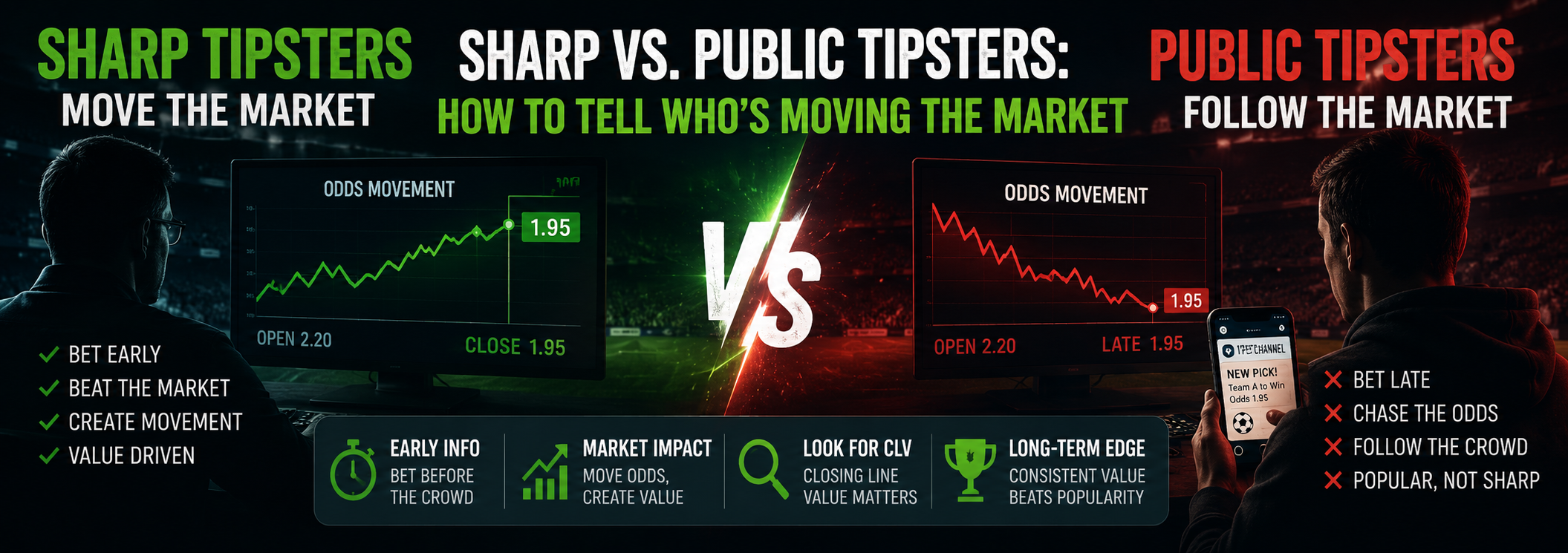
One of the easiest ways to evaluate a tipster is to observe the market after they publish a selection.
Ask yourself:
Do the odds immediately begin to shorten?
Do multiple bookmakers adjust within minutes?
Does the closing line finish significantly lower than the original price?
Consistent line movement doesn't automatically prove a tipster is sharp. But over hundreds of picks, it can indicate that they're identifying value before the market fully adjusts. If nothing happens after every release, it's possible the market simply doesn't consider the information significant.
Many bettors judge tipsters solely by their win-loss record. Sharp bettors pay close attention to timing. A tipster who consistently releases selections before major price movements may be providing far more value than someone with a slightly higher strike rate who posts after the market has already adjusted.
That's because value is created at the point of entry. Once the odds have moved, the same selection may no longer offer a profitable opportunity. The timing isn't just part of the strategy.
It is the strategy.
This is another common misunderstanding. Sharp tipsters don't win every bet.
They lose regularly.
What separates them isn't accuracy. It's price. They consistently secure odds that are higher than the true probability of the event. Over hundreds or even thousands of bets, those small pricing advantages compound into long-term profit.
That's why experienced bettors pay attention to metrics like:
Closing Line Value (CLV)
Return on Investment (ROI)
Long-term yield
These tell a much clearer story than win rate alone.
A tipster with 100,000 followers isn't automatically sharp. Likewise, a relatively unknown bettor with a small audience may consistently beat the market.
Popularity measures attention.
Sharpness measures edge.
Sometimes the two overlap.
Often they don't. The smartest bettors judge tipsters by their process, not their follower count.
One of the biggest advantages you can develop is learning to spot market behaviour without relying entirely on tipsters.
Pay attention to:
Opening odds
Line movement
Closing prices
Market reactions after major news
The more you understand why prices move, the less dependent you'll become on anyone else's opinion. Eventually, you'll recognise sharp action even before someone labels it.
The difference between a public tipster and a sharp tipster isn't fame.
It isn't confidence.
And it certainly isn't a flashy win rate. The real difference is whether they consistently identify value before the market does. Because in sports betting, the people who move the market aren't chasing the odds.
They're finding them before everyone else. And learning to recognise that difference is one of the most valuable skills any bettor can develop.




Copyright © 2019 SportsTrade.io and all its predictions.
We're concerned about problem gambling. For most people, gambling is entertainment - a fun activity that can be enjoyed without harmful effect. But for some, it's not just a game - it's a serious problem that continues even after the fun has gone.
Compulsive gambling is not easily detected. The person with a gambling problem will often go to great lengths to cover up the problem and will appear to look all right, regardless of the consequences of their gambling.
Warning Signs. Some of the indicators that a person may be suffering from a gambling problem include:
Losing time from work or family due to gambling.
Repeated failed attempts to stop or control gambling.
Borrowing money to gamble or pay gambling debts.
Gambling to escape worry or trouble.
Neglecting the care of one's self or family in order to gamble.
Lying about the amount of time and money spent on gambling.
Gambling more money in an attempt to win back losses.
Selling or pawning personal possessions to get money to gamble.
Feelings of hopelessness, depression, or suicide as a result of gambling.
Remember that help is available. By reaching out to people who understand, you can find the help you need. You can visit the Gambler's Anonymous website here:http://www.gamblersanonymous.org/ or Responsible Gaming Council here: http://www.responsiblegambling.org/
This is a non-profit organization not affiliated with us in any way.
It is an offence for persons under the age of eighteen (18) to make use of the Website. If we are unable to confirm that you are 18 years old then we may suspend your account until such time that we are able to confirm your age. If you are subsequently proven to have been under 18 years of age at the time you made any transactions with us, then:
Your Account will be closed.
All transactions on your account will be made void, and all related funds deposited by you will be returned by the payment method used for the deposit of such funds, wherever practicable.
Sportstrade is committed to providing the best service possible. We want our member to have confidence in our platform, and that's why we offer a Credit Back Guarantee to all tips without profits. This program comes into effect on the 01 July 2015 ('Effective Date') and is offered to ensure that member who made tips purchase of any tips that ended with either lose, draw, cancelled or postponed game. The credits will automatically refund to your account the next day and the information will be available after login in the member dashboard and available in 'transaction history' tab