
Imagine two football teams.
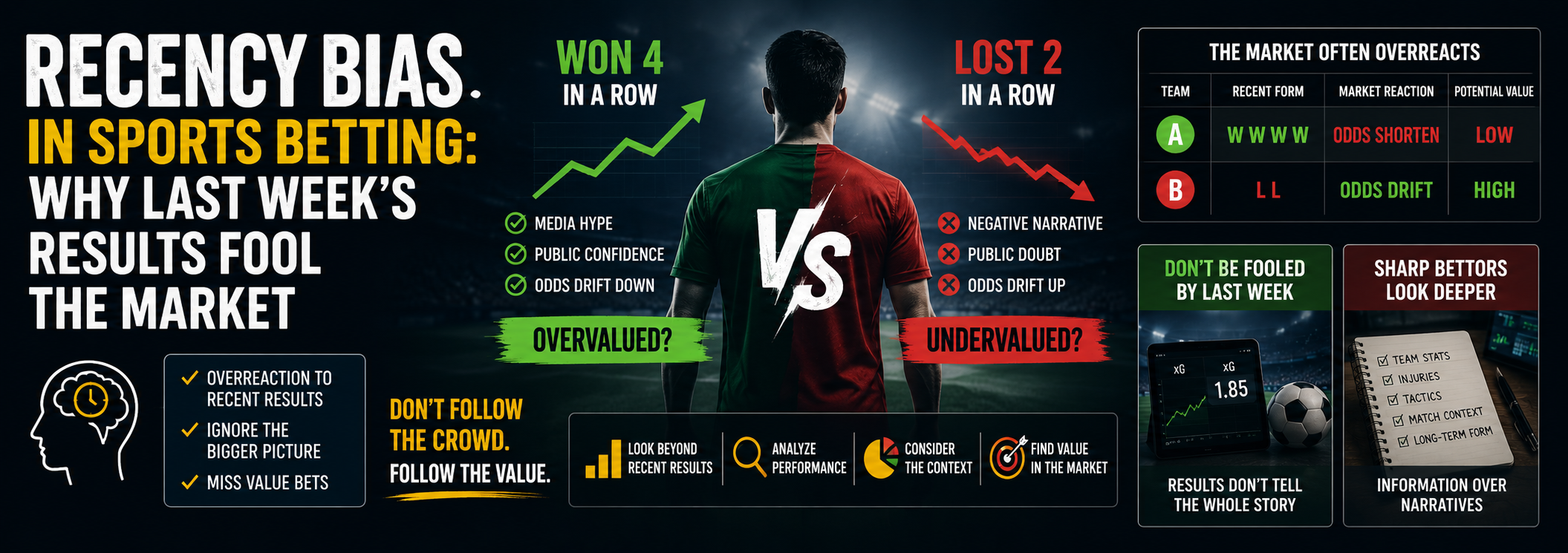
Team A has won its last four matches in convincing fashion. Headlines are calling them the hottest team in the league, fans are buzzing with confidence, and social media is filled with predictions that they'll continue their winning streak.
Team B, on the other hand, has just suffered two disappointing defeats. Pundits question their form, supporters are frustrated, and many bettors have already written them off.
Now ask yourself:
Which team is more likely to attract betting money this weekend? For most people, the answer is obvious. And that's exactly why recency bias exists.
Recency bias is one of the most powerful psychological traps in sports betting. It causes bettors to place too much weight on the most recent results while ignoring the larger body of evidence. In many cases, it doesn't just fool individual bettors—it influences the market itself.
Human beings are naturally wired to remember what happened most recently. If a striker scored a hat-trick last weekend, it feels like they're unstoppable. If a favourite lost 3–0, it feels like they're suddenly in crisis.
Recent events are vivid, emotional, and easy to recall. Older performances fade into the background, even though they often provide a much more accurate picture of a team's true ability. This mental shortcut helps us make quick decisions in everyday life.
In betting, however, it can become expensive.
One of the biggest mistakes bettors make is assuming recent success automatically means a team has become stronger.
Sometimes that's true.
But sometimes a winning streak is built on circumstances that are unlikely to repeat. Perhaps the team faced weaker opponents. Maybe they benefited from red cards, penalties, or fortunate deflections. Or perhaps they consistently outperformed the quality of chances they created.
Without looking deeper, bettors mistake short-term outcomes for long-term improvement. The market often follows the same narrative.
The opposite is equally true. A team coming off several defeats may actually be playing better than the results suggest.
Imagine a club that:
Creates more chances than its opponents
Dominates possession
Records a higher Expected Goals (xG) figure
Loses due to late goals or exceptional goalkeeping
Many bettors only see the final score. Sharp bettors see the underlying performance. This is where opportunities often emerge. When public opinion focuses on recent losses, prices can become more attractive than they should be.
Sports media thrives on momentum.
You'll often hear phrases like:
"The hottest team in the league."
"They can't stop winning."
"They're in terrible form."
"Confidence is gone."
These narratives create compelling stories. But bookmakers don't set odds based on headlines alone.
They consider:
Team quality
Injuries
Tactical matchups
Historical performance
Market activity
Professional bettors know that great stories don't always produce great bets.
Because so many bettors are influenced by recent performances, betting markets occasionally move too far in one direction. A team on a four-match winning streak may become overpriced because everyone wants to back them. Meanwhile, an equally capable opponent with recent poor results may become undervalued. This doesn't happen every week. But when it does, disciplined bettors pay attention. They're not betting against recent form. They're betting against the market's tendency to overvalue it.
One of the easiest ways to reduce recency bias is to stop judging teams by results alone.
Instead, ask questions like:
Were the performances actually convincing?
How strong were the opponents?
Did the team create quality chances?
Were the results influenced by luck?
Has anything fundamentally changed?
These questions shift your focus from outcomes to process. And that's where better betting decisions begin.
Professional bettors rarely judge a team based on one or two matches. Instead, they look for trends over a much larger sample. A team's last six to ten matches usually provide a more balanced picture than its last one or two.
Even then, those results should be viewed alongside:
Squad strength
Injuries
Schedule difficulty
Home and away performance
Statistical indicators
The larger the sample, the less likely you are to be fooled by short-term variance.
The goal isn't to ignore recent form. Recent performances absolutely matter. The key is knowing how much they should matter. When the public places too much emphasis on last week's result, opportunities can appear elsewhere. Sometimes the best value comes from backing the team everyone has just given up on. Other times, it comes from avoiding the team everyone suddenly believes is unbeatable.
The edge lies in finding the balance.
Last week's result is only one chapter of the story. Unfortunately, many bettors treat it as the entire book. Recency bias causes people to chase winning streaks, abandon good teams too quickly, and overreact to short-term outcomes. The smartest bettors take a different approach. They look beyond the headlines. They study the bigger picture. Because in sports betting, the market often remembers yesterday more vividly than it should. And that's where tomorrow's value is often hiding.




Copyright © 2019 SportsTrade.io and all its predictions.
We're concerned about problem gambling. For most people, gambling is entertainment - a fun activity that can be enjoyed without harmful effect. But for some, it's not just a game - it's a serious problem that continues even after the fun has gone.
Compulsive gambling is not easily detected. The person with a gambling problem will often go to great lengths to cover up the problem and will appear to look all right, regardless of the consequences of their gambling.
Warning Signs. Some of the indicators that a person may be suffering from a gambling problem include:
Losing time from work or family due to gambling.
Repeated failed attempts to stop or control gambling.
Borrowing money to gamble or pay gambling debts.
Gambling to escape worry or trouble.
Neglecting the care of one's self or family in order to gamble.
Lying about the amount of time and money spent on gambling.
Gambling more money in an attempt to win back losses.
Selling or pawning personal possessions to get money to gamble.
Feelings of hopelessness, depression, or suicide as a result of gambling.
Remember that help is available. By reaching out to people who understand, you can find the help you need. You can visit the Gambler's Anonymous website here:http://www.gamblersanonymous.org/ or Responsible Gaming Council here: http://www.responsiblegambling.org/
This is a non-profit organization not affiliated with us in any way.
It is an offence for persons under the age of eighteen (18) to make use of the Website. If we are unable to confirm that you are 18 years old then we may suspend your account until such time that we are able to confirm your age. If you are subsequently proven to have been under 18 years of age at the time you made any transactions with us, then:
Your Account will be closed.
All transactions on your account will be made void, and all related funds deposited by you will be returned by the payment method used for the deposit of such funds, wherever practicable.
Sportstrade is committed to providing the best service possible. We want our member to have confidence in our platform, and that's why we offer a Credit Back Guarantee to all tips without profits. This program comes into effect on the 01 July 2015 ('Effective Date') and is offered to ensure that member who made tips purchase of any tips that ended with either lose, draw, cancelled or postponed game. The credits will automatically refund to your account the next day and the information will be available after login in the member dashboard and available in 'transaction history' tab