
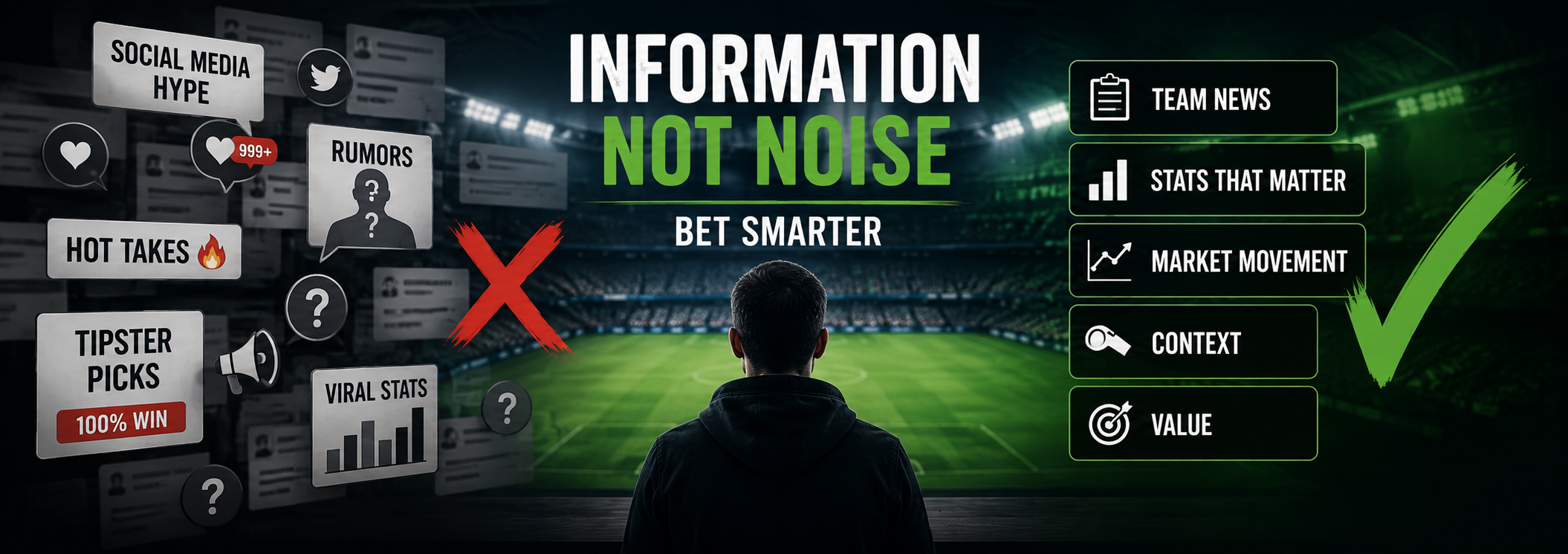
Sports betting has never been more data-driven. With a few taps on a smartphone, bettors can access advanced statistics, team news, betting tips, predictive models, injury updates, and live market movements from around the world. While this abundance of information should, in theory, make betting decisions easier, many bettors find themselves becoming less confident rather than more informed.
The reason is simple: not all information has value.
Professional bettors understand that profitable betting is not about consuming the largest amount of information. Instead, it is about identifying the small percentage of information that genuinely changes the probability of an outcome while ignoring everything else. Learning to separate meaningful information from background noise is one of the most valuable skills a sports trader can develop, because every unnecessary distraction increases the likelihood of making emotional or poorly informed decisions.
Unlike a decade ago, today's bettors are surrounded by an endless stream of content before every sporting event. Social media platforms are filled with opinions, Telegram groups share dozens of daily selections, AI prediction tools generate probabilities, and sports websites publish countless statistics and previews.
The problem is that information is no longer scarce—it is overwhelming.
Many bettors fall into the trap of believing that reading more articles, following more tipsters, or analysing more statistics will naturally improve their results. In reality, excessive information often creates confusion rather than clarity. Conflicting opinions make bettors second-guess themselves, while irrelevant statistics distract them from the factors that genuinely influence a match.
Successful bettors don't attempt to absorb everything. Instead, they develop a process for filtering information and focusing only on what improves their decision-making.
Useful information changes your assessment of a betting market.
Noise simply keeps your attention without changing the true probability of an outcome.
For example, confirmed team line-ups, significant injuries, tactical changes, weather conditions, or unexpected market movement can materially affect the chances of a team winning. These are examples of information that deserves attention because they alter the underlying conditions of the event.
By contrast, viral social media posts, emotional fan reactions, sensational headlines, and historical statistics with little relevance to the current squads often generate discussion without providing genuine betting value. They may influence public opinion, but they rarely improve your ability to identify profitable bets.
The key question every bettor should ask is:
"Does this information actually change the probability of the outcome?"
If the answer is no, it is probably just noise.
Modern analytics have transformed sports betting, but statistics can become misleading when they're viewed without context.
Many bettors collect dozens of metrics before placing a wager, including possession percentages, total shots, passing accuracy, corners, tackles, and countless advanced statistics. While these numbers may appear comprehensive, not all of them contribute equally to predicting a specific market.
For example, a football team may dominate possession while creating very few genuine scoring opportunities. Another team may have less possession but consistently produce high-quality chances reflected in their Expected Goals (xG). If you're betting on the Over/Under goals market, shot quality may be far more meaningful than ball possession alone.
Statistics become valuable only when they help answer the question you're trying to solve. Collecting more numbers without understanding their relevance often creates analysis paralysis instead of better decisions.
Sports media exists to attract attention. Headlines such as "Team X Can't Stop Winning" or "Club Y Is in Crisis" generate clicks, discussions, and engagement. These narratives quickly spread across television, podcasts, YouTube channels, and betting communities, eventually influencing public perception.
The betting market, however, doesn't simply reward popular opinions.
Bookmakers and professional traders evaluate a much wider range of factors, including player availability, tactical matchups, scheduling, historical performance, and market activity. While public narratives may influence betting volumes, they don't necessarily reflect the true probability of an outcome.
Experienced bettors understand that compelling stories are not evidence. Before allowing a headline to influence your decision, it's worth asking whether the underlying facts actually support the narrative.
One habit shared by successful bettors is consistency in their research process.
Rather than constantly searching for new sources, they identify a small number of reliable resources and use them repeatedly. Their focus is usually directed toward information that has proven value, such as official team announcements, trusted statistical databases, verified injury reports, and market movement from respected bookmakers or exchanges.
At the same time, they deliberately reduce exposure to sources that generate more excitement than insight. Constantly refreshing social media feeds or jumping between conflicting predictions often adds unnecessary uncertainty rather than improving decision quality.
Creating a personal information filter allows bettors to spend less time consuming content and more time evaluating whether a betting opportunity genuinely offers value.
One reason bettors become overwhelmed by information is a lack of confidence in their own analysis.
After researching a match, they read one more opinion on social media that contradicts their conclusion. Suddenly, doubt appears. They continue searching for additional confirmation until kickoff, often changing their decision multiple times.
Professional bettors recognise that no amount of information can eliminate uncertainty completely. Instead of seeking endless confirmation, they rely on a structured process that has been tested over time.
If new information genuinely changes the probability of the event, they adjust accordingly. If it doesn't, they remain disciplined and trust their original analysis.
This ability to distinguish between meaningful updates and emotional distractions is one of the defining characteristics of long-term profitable betting.
Many recreational bettors assume that successful betting requires consuming more information than everyone else.
In reality, the opposite is often true.
Professional sports traders typically rely on a smaller number of high-quality information sources because they understand that relevance is far more important than volume. Five pieces of reliable information that directly affect the market are far more valuable than fifty opinions that simply repeat the same narrative.
Betting is ultimately a decision-making exercise. The goal is not to know everything about a match—it is to know enough to identify whether the available odds represent value.
The digital age has given sports bettors access to more information than ever before, but access alone does not create an edge. In many cases, the greatest challenge is not finding information but filtering out everything that doesn't matter.
Successful bettors learn to focus on facts that genuinely influence probability, while ignoring sensational headlines, emotional opinions, and statistics that add complexity without improving accuracy. By building a disciplined research process and trusting reliable sources, you can reduce distractions, make clearer decisions, and develop a more consistent approach to sports trading.
In the long run, separating information from noise won't just save you time—it can become one of the biggest advantages you have over the average bettor.




Copyright © 2019 SportsTrade.io and all its predictions.
We're concerned about problem gambling. For most people, gambling is entertainment - a fun activity that can be enjoyed without harmful effect. But for some, it's not just a game - it's a serious problem that continues even after the fun has gone.
Compulsive gambling is not easily detected. The person with a gambling problem will often go to great lengths to cover up the problem and will appear to look all right, regardless of the consequences of their gambling.
Warning Signs. Some of the indicators that a person may be suffering from a gambling problem include:
Losing time from work or family due to gambling.
Repeated failed attempts to stop or control gambling.
Borrowing money to gamble or pay gambling debts.
Gambling to escape worry or trouble.
Neglecting the care of one's self or family in order to gamble.
Lying about the amount of time and money spent on gambling.
Gambling more money in an attempt to win back losses.
Selling or pawning personal possessions to get money to gamble.
Feelings of hopelessness, depression, or suicide as a result of gambling.
Remember that help is available. By reaching out to people who understand, you can find the help you need. You can visit the Gambler's Anonymous website here:http://www.gamblersanonymous.org/ or Responsible Gaming Council here: http://www.responsiblegambling.org/
This is a non-profit organization not affiliated with us in any way.
It is an offence for persons under the age of eighteen (18) to make use of the Website. If we are unable to confirm that you are 18 years old then we may suspend your account until such time that we are able to confirm your age. If you are subsequently proven to have been under 18 years of age at the time you made any transactions with us, then:
Your Account will be closed.
All transactions on your account will be made void, and all related funds deposited by you will be returned by the payment method used for the deposit of such funds, wherever practicable.
Sportstrade is committed to providing the best service possible. We want our member to have confidence in our platform, and that's why we offer a Credit Back Guarantee to all tips without profits. This program comes into effect on the 01 July 2015 ('Effective Date') and is offered to ensure that member who made tips purchase of any tips that ended with either lose, draw, cancelled or postponed game. The credits will automatically refund to your account the next day and the information will be available after login in the member dashboard and available in 'transaction history' tab