
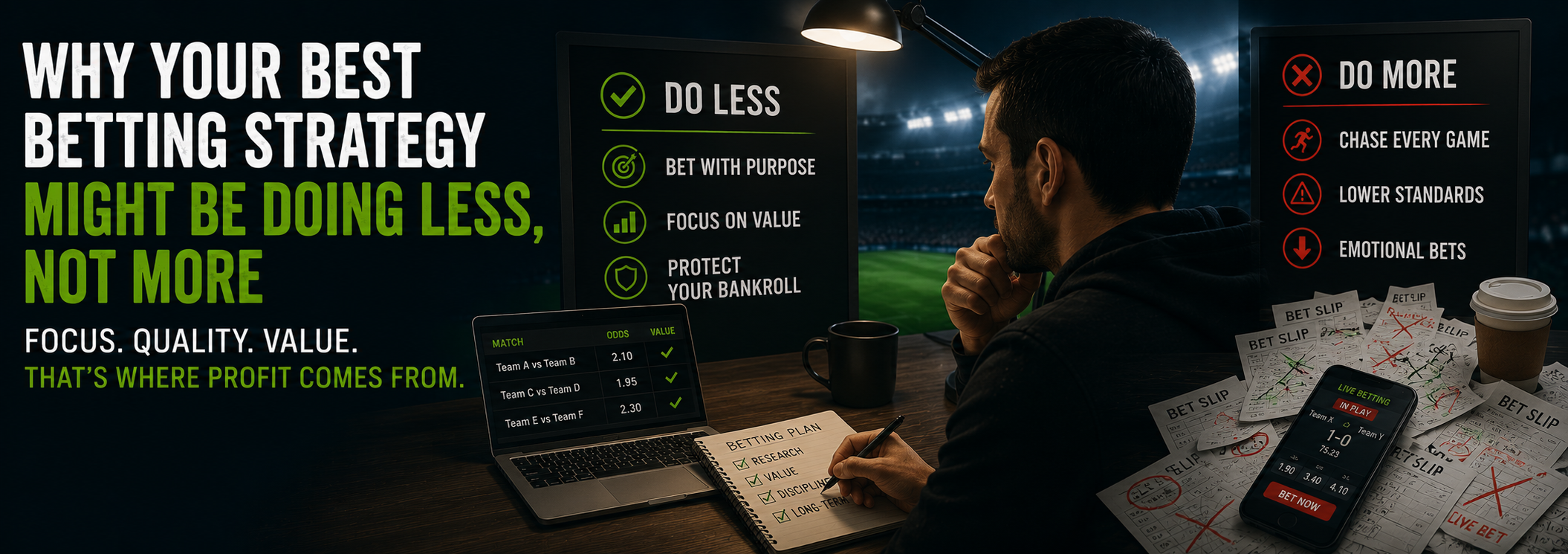
Sports betting creates a powerful temptation to stay active. There is always another football match starting, another live market moving, another tipster releasing a selection, and another opportunity that appears too good to ignore. With hundreds of events available every day, doing nothing can feel like wasting an opportunity.
That mindset creates one of the most common problems among bettors: overbetting.
Many bettors assume that increasing the number of bets they place will naturally increase their chances of making money. If they have an edge, more bets should mean more opportunities to use that edge. While there is some mathematical logic behind that idea, it only works when every additional bet meets the same quality standard.
In reality, increasing betting volume often leads people to lower their standards. Instead of waiting for genuine value, they begin manufacturing reasons to bet. Marginal opportunities become acceptable, unfamiliar leagues enter the portfolio, and entertainment gradually replaces disciplined decision-making. For many bettors, the next major improvement in performance may therefore come from something surprisingly simple: betting less.
Betting volume only becomes valuable when the underlying decisions have positive expected value. Placing 100 well-researched bets with a genuine edge can make sense. Placing another 200 mediocre bets simply because more matches are available does not strengthen the strategy.
This distinction sounds obvious, yet it is easy to forget when markets are constantly available. A bettor might begin the weekend with strict selection criteria but gradually become less selective after seeing dozens of fixtures. A match that would normally be ignored suddenly becomes interesting because it is televised. A small line movement becomes a reason to enter. An unfamiliar league gets added because a tipster has posted a confident selection.
The result is often a portfolio containing a small number of strong bets surrounded by a much larger number of average ones. If your strongest opportunities have an edge but your weaker selections are close to break-even or negative expected value, increasing volume can dilute rather than improve your overall performance. Activity is not the same thing as productivity.
Not every bet begins with analysis. Some begin because there is nothing else happening. This is particularly common with live betting. A bettor watches a match without initially intending to wager, but after 20 minutes starts searching for an opportunity. Possession statistics, shots, corners or momentum are used to justify a position that probably would never have been considered before the match.
The psychological problem is that once someone opens a betting platform, doing nothing feels passive. Placing a bet creates excitement and gives the match a sense of purpose.
Professional trading requires the opposite mindset. Observing a market and deciding not to participate is still a decision. If the available price doesn't provide enough value, staying out protects capital that can be used when a stronger opportunity appears. A no-bet decision may not appear in your profit-and-loss statement, but avoiding a negative-value position still matters to long-term performance.
Suppose your betting process produces ten potential selections during a weekend. Two look exceptionally strong, three are reasonably attractive, and the remaining five only marginally satisfy your criteria.
A high-volume bettor may take all ten because each selection technically passes the minimum threshold. A more selective bettor may concentrate only on the strongest opportunities. Neither approach is automatically correct, but the second forces an important question: where is your actual edge strongest?
Reviewing historical results can help answer this. You may discover that your profitability comes primarily from particular leagues, odds ranges, market types or situations. The rest of your activity may contribute very little—or even reduce your returns. Once this becomes visible, betting less stops looking conservative. It becomes a form of optimisation. Instead of asking, "How many bets can I find?" the better question becomes, "Which bets genuinely deserve my capital?"
Every betting decision consumes attention. Researching matches, comparing odds, following market movements and evaluating new information all require mental effort. As the number of decisions increases, maintaining the same level of concentration becomes difficult.
This matters even more in live markets. A bettor who has been monitoring matches for six hours is unlikely to process information with the same clarity as they did during the first hour. Small mistakes become more likely. Discipline weakens, stakes become inconsistent, and emotional reactions become harder to control.
Reducing unnecessary betting volume can therefore improve more than your selection quality. It can improve the quality of your thinking. A trader who focuses deeply on five opportunities may understand those positions significantly better than someone attempting to monitor thirty markets simultaneously. Specialisation creates room for deeper analysis, better record-keeping and more thoughtful post-bet reviews.
One of the hardest skills in sports betting is learning to reject opportunities. A match can be interesting without being bettable. A prediction can be correct without offering value. A tipster can make a convincing argument without the available odds being attractive enough to follow.
Experienced bettors understand these distinctions because they are not trying to participate in every market. Their objective is not constant action; it is efficient allocation of bankroll. This is similar to financial trading. A disciplined investor doesn't buy every stock that moves, and a professional trader doesn't enter a position simply because the market is open. Capital is deployed when the expected opportunity justifies the risk.
Sports betting should be approached the same way. Your bankroll is limited capital, and every bet competes for a portion of it.
If you suspect overbetting is hurting your performance, the answer doesn't have to be guesswork. Test it. Review your betting history and separate your strongest selections from your marginal ones. Compare their ROI, average odds, Closing Line Value (CLV), and overall profitability. You may discover that a surprisingly small percentage of your bets generate most of your positive results.
Another useful exercise is to temporarily reduce your betting volume. For several weeks, require every selection to meet stricter criteria before entering. Record the bets you take as well as the ones you deliberately reject.
The objective isn't simply to increase win rate. A higher strike rate can be meaningless if the prices are poor. Instead, examine whether stricter selection improves your average expected value, CLV, ROI and consistency. You may find that fewer bets make your results easier to analyse because the reasoning behind each position becomes clearer.
Betting less does not mean becoming afraid to take risks. Excessive caution can also become a problem if it prevents you from acting when genuine value exists. The objective is not minimum volume. It is optimal volume.
If your strategy consistently identifies positive expected value across hundreds of markets, then higher volume may be appropriate. Professional quantitative bettors can place enormous numbers of wagers because their systems are specifically designed to identify and execute small edges repeatedly.
But that is very different from a recreational bettor placing more bets because they want more action. Volume should be the result of opportunities meeting your criteria. Your criteria should never become weaker simply because you want more volume.
A useful way to reduce unnecessary activity is to introduce friction into your decision-making process. Before entering a position, require yourself to explain why the bet deserves to exist.
What information supports the position? What probability have you assigned to the outcome? How does that compare with the implied probability of the available odds? Has the market moved significantly? Would you still place the bet if the match were not televised or recommended by someone you follow?
You don't need a complicated mathematical model for every selection. The purpose is to prevent impulse from masquerading as analysis. If you cannot clearly explain where the expected edge comes from, passing may be the better decision.
Sports betting platforms are designed around constant availability. There is always another match, market or opportunity waiting for attention. That abundance can make activity feel productive, even when it isn't.
Successful betting requires a different mindset. The objective is not to place as many bets as possible but to allocate capital to situations where you believe the available price provides genuine value. For some strategies, that will still mean high volume. For others, particularly discretionary bettors and sports traders, reducing volume can improve research quality, reduce decision fatigue, prevent emotional betting and reveal where the strongest edges actually exist.
Sometimes improving a betting strategy doesn't require another model, another statistic or another tipster.
Sometimes it requires deleting half the bets.
Because in sports trading, doing more creates more action. Doing less—but doing it better—may create better decisions.




Copyright © 2019 SportsTrade.io and all its predictions.
We're concerned about problem gambling. For most people, gambling is entertainment - a fun activity that can be enjoyed without harmful effect. But for some, it's not just a game - it's a serious problem that continues even after the fun has gone.
Compulsive gambling is not easily detected. The person with a gambling problem will often go to great lengths to cover up the problem and will appear to look all right, regardless of the consequences of their gambling.
Warning Signs. Some of the indicators that a person may be suffering from a gambling problem include:
Losing time from work or family due to gambling.
Repeated failed attempts to stop or control gambling.
Borrowing money to gamble or pay gambling debts.
Gambling to escape worry or trouble.
Neglecting the care of one's self or family in order to gamble.
Lying about the amount of time and money spent on gambling.
Gambling more money in an attempt to win back losses.
Selling or pawning personal possessions to get money to gamble.
Feelings of hopelessness, depression, or suicide as a result of gambling.
Remember that help is available. By reaching out to people who understand, you can find the help you need. You can visit the Gambler's Anonymous website here:http://www.gamblersanonymous.org/ or Responsible Gaming Council here: http://www.responsiblegambling.org/
This is a non-profit organization not affiliated with us in any way.
It is an offence for persons under the age of eighteen (18) to make use of the Website. If we are unable to confirm that you are 18 years old then we may suspend your account until such time that we are able to confirm your age. If you are subsequently proven to have been under 18 years of age at the time you made any transactions with us, then:
Your Account will be closed.
All transactions on your account will be made void, and all related funds deposited by you will be returned by the payment method used for the deposit of such funds, wherever practicable.
Sportstrade is committed to providing the best service possible. We want our member to have confidence in our platform, and that's why we offer a Credit Back Guarantee to all tips without profits. This program comes into effect on the 01 July 2015 ('Effective Date') and is offered to ensure that member who made tips purchase of any tips that ended with either lose, draw, cancelled or postponed game. The credits will automatically refund to your account the next day and the information will be available after login in the member dashboard and available in 'transaction history' tab