
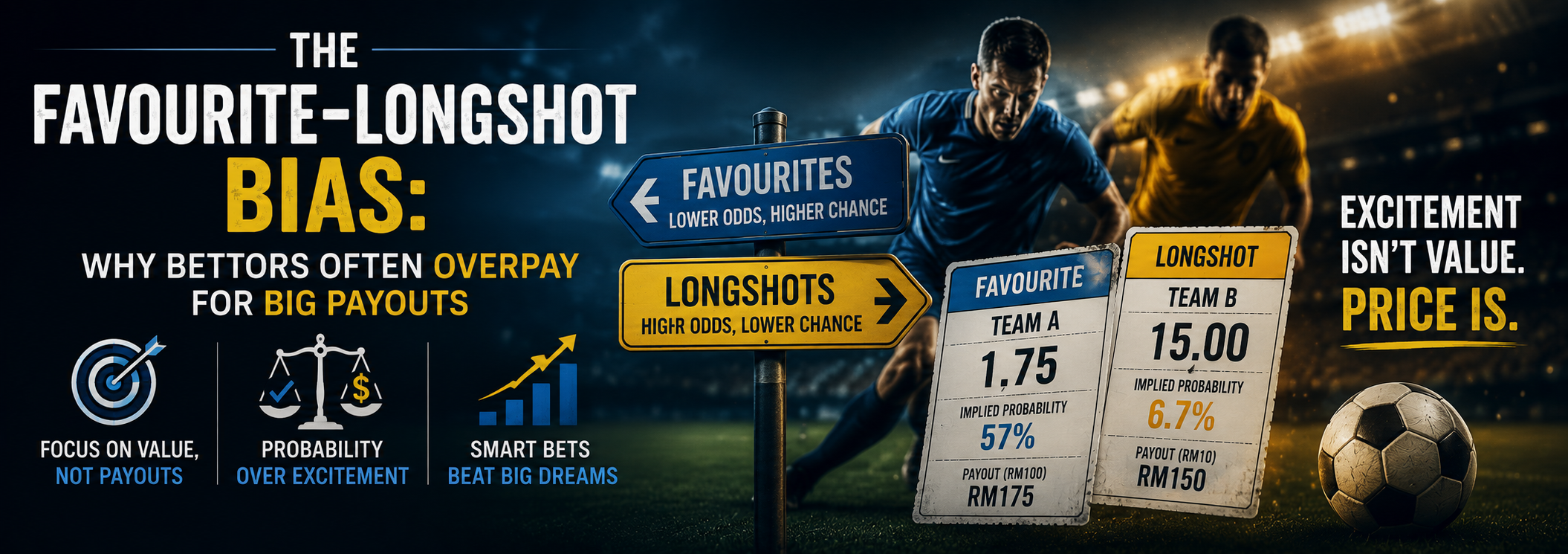
There is something naturally appealing about turning a small stake into a large payout. A RM10 bet at odds of 15.00 feels more exciting than the same stake at 1.80, even though the higher potential return tells us nothing about whether either bet represents good value. This attraction to unlikely outcomes is connected to a well-known phenomenon in betting markets called the favourite–longshot bias. In simple terms, bettors can be willing to pay too much for low-probability outcomes with potentially large payouts. As demand for those selections increases, their odds may become less attractive relative to their true chances of winning. The lesson isn't that longshots should never be backed or that favourites are automatically profitable. The important point is that payout size and betting value are two completely different things. Understanding that distinction can prevent bettors from repeatedly paying a premium for excitement.
Sports betting isn't driven purely by mathematics. Emotion plays a major role, and few things generate more excitement than imagining an unlikely outcome producing a significant return. Consider the psychological difference between two bets. One offers odds of 1.70, while another offers 12.00. The first may have a much stronger probability-based case, but the second immediately creates a more interesting possibility: a relatively small stake could produce a memorable payout. That potential reward can influence how bettors evaluate risk. Instead of asking whether 12.00 accurately reflects the probability of the outcome, they begin thinking about what they could do with the winnings. The focus quietly moves from probability to payout.
Lotteries operate on a similar psychological principle. The probability of winning may be extremely small, but the size of the jackpot makes participation attractive. Sports betting markets are considerably more complex, but the same preference for asymmetric payouts can influence how bettors approach outsiders, correct scores, accumulators and other low-probability selections.
One of the most important concepts in sports betting is that attractive odds are not necessarily valuable odds. Suppose a football team is available at 10.00. Those odds imply a probability of roughly 10% before accounting for bookmaker margin. If your analysis suggests the team's realistic chance of winning is only 6%, then 10.00 isn't generous at all. The potential payout is large, but the price is still too short for the actual risk. Now consider a favourite available at 1.80. The potential payout is far less exciting, but if you estimate the team's true winning probability at 60%, the bet may offer considerably better value.
This is why experienced bettors don't classify bets as attractive simply because the odds are high or low. They compare the available price with their estimate of the true probability. A longshot at 20.00 can be terrible value. A favourite at 1.50 can be excellent value. The reverse can also be true. Value depends on price relative to probability—not the size of the potential payout.
Betting markets are shaped partly by supply and demand. When large numbers of recreational bettors prefer particular types of selections, bookmakers and exchanges can respond to that demand.
Longshots are particularly attractive because they create strong stories. An underdog winning a major match is memorable. A 50/1 selection landing generates screenshots, social media posts and conversations. Nobody gets the same emotional reaction from repeatedly backing correctly priced favourites at 1.60. This difference in attention can distort perception. Bettors remember spectacular wins far more easily than the dozens of unsuccessful longshot bets that came before them. If enough money consistently chases these outcomes, bettors may end up accepting prices that don't adequately compensate them for the probability of losing. The potential payout remains large, but the expected return may be poor. That is the essence of the favourite–longshot bias.
The attraction to big payouts becomes even more obvious with accumulators and parlays. A bettor may look at six selections individually and think each one seems reasonable. When combined, however, the ticket suddenly offers odds of 25.00 or 40.00. The possibility of turning a small stake into a substantial return becomes difficult to resist. But every additional leg introduces another opportunity for the bet to fail. Bookmaker margins can also compound across multiple selections, meaning the headline payout may be less attractive than it appears when compared with the combined true probabilities.
This doesn't mean accumulators should never be used. It means the decision should still be based on expected value rather than the excitement of the final odds. If the main reason for placing a bet is that "RM20 could become RM800," you're evaluating the reward before properly evaluating the probability. That is precisely the mindset disciplined bettors try to avoid.
One of the most dangerous aspects of longshot betting is that occasional success can validate a poor process. Imagine someone regularly betting outsiders without considering whether the prices offer genuine value. After numerous losses, one 15.00 selection finally wins and recovers much of the previous damage.
Psychologically, that win is powerful. Instead of reviewing all the unsuccessful bets, the bettor remembers the large payout and becomes more confident that the strategy works. This is where results can become misleading.
A bad bet can win, just as a good bet can lose. The quality of a betting decision cannot be judged from one outcome. A bettor who repeatedly takes 10.00 on events that should actually be priced at 15.00 may occasionally enjoy spectacular wins, but the strategy remains mathematically poor. Conversely, someone consistently obtaining 10.00 on events with fair odds closer to 8.00 can lose several times while still making sensible decisions. Over a sufficiently large sample, price matters more than memorable individual results.
No.
The term "favourite–longshot bias" can easily be misunderstood as an argument for blindly backing favourites. That would simply replace one oversimplification with another. Favourites can also be overpriced. Popular teams, superstar athletes and dominant champions frequently attract large amounts of recreational money. In major football leagues, for example, supporters may be willing to back famous clubs at prices that disciplined bettors consider unattractive. The objective is therefore not to choose favourites over outsiders. It is to avoid having a preference based purely on odds category.
A professional approach should be indifferent to whether a selection is priced at 1.50, 3.00 or 15.00. If the probability assessment indicates positive expected value and the risk fits the betting strategy, the opportunity can be considered. The price should determine whether the bet is attractive—not whether the potential payout looks exciting.
A simple way to reduce longshot bias is to reverse the normal betting process. Instead of seeing the odds first and imagining the potential return, estimate the probability of the outcome before focusing on the payout. If you believe a team has approximately a 25% chance of winning, your assessment corresponds to fair decimal odds around 4.00. If the market offers 5.00, there may be value worth investigating. If it offers only 3.20, the selection may be unattractive regardless of how strongly you believe the team could win.
Thinking this way forces you to evaluate risk before reward. It also makes comparisons easier. A bettor can evaluate a 1.80 favourite and an 8.00 outsider using exactly the same framework: Does the available price compensate me adequately for the probability I'm taking? Once that becomes the central question, the emotional appeal of the headline payout becomes much less important.
If you maintain a betting journal, you can test whether favourite–longshot bias is affecting your own results. Separate your historical bets into different odds ranges and compare their long-term performance. You might discover that your bets above 5.00 consistently produce poor returns, even though several memorable winners made the category feel successful.
Alternatively, your records may show that you genuinely identify value among outsiders. If so, there is no reason to stop simply because the selections carry high odds. The important part is using evidence rather than assumptions. Betting records can reveal whether you are finding mispriced longshots or simply buying expensive lottery tickets disguised as sports analysis.
Big payouts will always be part of the appeal of sports betting. There is nothing unusual about finding a 20.00 winner more exciting than collecting a modest return from a short-priced favourite. The mistake begins when excitement influences how value is assessed. The favourite–longshot bias reminds bettors that low-probability outcomes can become overpriced precisely because people enjoy chasing them. A large potential payout does not compensate for poor odds if the true probability is even lower than the market suggests.
At the same time, the solution isn't to automatically avoid outsiders or blindly back favourites. Both can offer value, and both can be badly priced. The better approach is much simpler: stop asking how much a bet could win and start asking whether the odds are worth the risk. In sports trading, the biggest payout isn't necessarily the best opportunity. Sometimes it is simply the most expensive dream on the board.




Copyright © 2019 SportsTrade.io and all its predictions.
We're concerned about problem gambling. For most people, gambling is entertainment - a fun activity that can be enjoyed without harmful effect. But for some, it's not just a game - it's a serious problem that continues even after the fun has gone.
Compulsive gambling is not easily detected. The person with a gambling problem will often go to great lengths to cover up the problem and will appear to look all right, regardless of the consequences of their gambling.
Warning Signs. Some of the indicators that a person may be suffering from a gambling problem include:
Losing time from work or family due to gambling.
Repeated failed attempts to stop or control gambling.
Borrowing money to gamble or pay gambling debts.
Gambling to escape worry or trouble.
Neglecting the care of one's self or family in order to gamble.
Lying about the amount of time and money spent on gambling.
Gambling more money in an attempt to win back losses.
Selling or pawning personal possessions to get money to gamble.
Feelings of hopelessness, depression, or suicide as a result of gambling.
Remember that help is available. By reaching out to people who understand, you can find the help you need. You can visit the Gambler's Anonymous website here:http://www.gamblersanonymous.org/ or Responsible Gaming Council here: http://www.responsiblegambling.org/
This is a non-profit organization not affiliated with us in any way.
It is an offence for persons under the age of eighteen (18) to make use of the Website. If we are unable to confirm that you are 18 years old then we may suspend your account until such time that we are able to confirm your age. If you are subsequently proven to have been under 18 years of age at the time you made any transactions with us, then:
Your Account will be closed.
All transactions on your account will be made void, and all related funds deposited by you will be returned by the payment method used for the deposit of such funds, wherever practicable.
Sportstrade is committed to providing the best service possible. We want our member to have confidence in our platform, and that's why we offer a Credit Back Guarantee to all tips without profits. This program comes into effect on the 01 July 2015 ('Effective Date') and is offered to ensure that member who made tips purchase of any tips that ended with either lose, draw, cancelled or postponed game. The credits will automatically refund to your account the next day and the information will be available after login in the member dashboard and available in 'transaction history' tab