
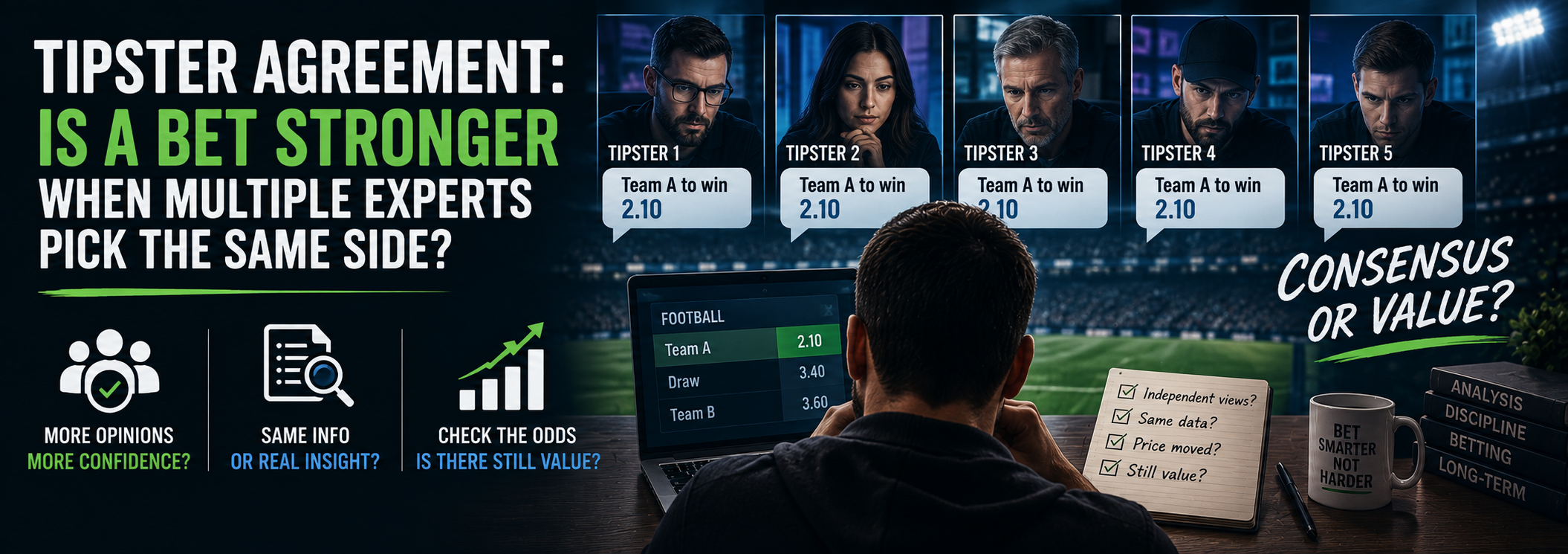
You are researching a football match and notice something interesting. One respected tipster backs the home team. Then another does the same. You check a third source and find exactly the same selection.
Suddenly, the bet feels much stronger. This is understandable. When several knowledgeable people independently reach the same conclusion, it seems reasonable to assume that their combined opinion should carry more weight. In sports betting, this is often described as tipster consensus or agreement. But there is an important problem: three tipsters making the same pick does not necessarily mean you have three independent pieces of evidence. They may be using the same statistics, reacting to the same news, following the same market movement or even indirectly copying the same original source. In those situations, apparent consensus can create confidence without adding much new information.
The real question, therefore, isn't how many tipsters agree. It is why they agree—and whether their agreement actually provides additional evidence that the market price is wrong.
Humans naturally gain confidence when other people confirm their opinions. If you already believe Manchester City should win and then discover that five analysts agree with you, your original view suddenly feels validated.
In betting, this effect can become particularly strong because uncertainty is uncomfortable. Nobody knows the outcome of a sporting event in advance, so agreement from several experts can make an uncertain decision feel safer. This is one reason bettors frequently search for additional predictions after already identifying a selection they like. They aren't always looking for new information; sometimes they're looking for reassurance.
The danger is that confidence can increase much faster than the actual probability of winning. Five people repeating the same argument do not automatically make that argument five times stronger.
There are circumstances where multiple tipsters choosing the same selection genuinely deserves attention. Suppose three proven analysts independently evaluate the same match using very different methods. One specialises in statistical modelling, another focuses heavily on tactical analysis, and a third has strong knowledge of the specific league and local team information. If all three independently conclude that the same selection is undervalued at similar odds, their agreement can be meaningful. Different analytical processes have arrived at the same conclusion, reducing the possibility that the bet depends entirely on one assumption.
This is similar to obtaining independent opinions in other fields. Agreement becomes more informative when the sources reach their conclusions separately. The important word is independently. Without independence, the number of tipsters agreeing can become misleading.
Modern betting information spreads extremely quickly. A respected bettor posts a selection, odds begin moving, betting communities notice the movement, and other tipsters start discussing the same side. Within an hour, it may appear that ten different experts have independently discovered the same opportunity.
In reality, many of them may be reacting to the same original signal. The same problem occurs with data. Numerous tipsters use similar Expected Goals databases, injury websites, prediction models and odds-comparison tools. Their analysis may look independent because it comes from different accounts, yet the underlying inputs are almost identical. If five analysts use essentially the same model and the same information, their agreement should not be treated like five separate confirmations.
This is known more broadly as correlated information. The sources appear different, but their conclusions are connected. For bettors, distinguishing genuine independent consensus from repeated information is crucial.
There is another problem with waiting for multiple tipsters to agree: the market may move before you act. Imagine the first respected tipster recommends a selection at 2.20. A second tipster agrees shortly afterward, and the odds fall to 2.05. By the time several more experts support the same bet, the price has shortened to 1.85.
At that point, you have more confirmation—but potentially less value. This creates an interesting contradiction. Waiting for consensus may increase your confidence in the selection while simultaneously making the actual bet worse. Remember that a betting recommendation isn't valuable simply because the prediction is correct. The available odds must still compensate you for the probability of losing.
A strong selection at 2.20 can become an average bet at 2.00 and a poor bet at 1.75. Consensus cannot rescue a bad price.
Social media makes this problem even more pronounced. Popular opinions spread faster than unpopular ones, and algorithms often expose users to content similar to what they have already viewed. A bettor may open several platforms and repeatedly encounter the same prediction. It feels as though the entire betting community has independently reached the same conclusion. But that perception can be deceptive.
One influential prediction may have been reposted, rewritten, discussed and repeated dozens of times. What looks like widespread expert agreement may actually be an echo chamber built around a single idea. This is why counting recommendations is a weak way to evaluate a bet. Understanding the reasoning behind those recommendations is much more useful.
If several tipsters recommend the same bet, look at how they reached that conclusion. Suppose three analysts all back the home team. One believes the opponent's defensive structure is vulnerable. Another identifies strong underlying home performance that recent results have hidden. The third believes the current market price underestimates the impact of returning players. That agreement is much more interesting than three tipsters simply saying the home side is "in good form."
Different reasoning provides multiple ways to challenge your own analysis. It may reveal factors you missed and help determine whether the market genuinely appears mispriced. If every tipster repeats the same statistic, however, additional recommendations may contribute almost nothing. The objective isn't to collect votes. It is to collect useful information.
Some betting platforms aggregate predictions and show percentages such as "78% of experts back Team A." These numbers can be useful for understanding market sentiment, but they should not automatically be interpreted as probability estimates. The quality of the underlying tipsters matters. Their historical records matter. Their specialisations matter. The odds at which their selections were originally released also matter.
Twenty unverified tipsters agreeing on a selection do not necessarily provide stronger evidence than one specialist with a long, transparent record in that particular market. Consensus without quality control can simply measure popularity. And popularity is not the same thing as value.
A better way to use several tipsters is to treat them as sources of research rather than votes. If one analyst identifies an interesting position, examine the reasoning. Check whether other credible analysts have independently noticed similar factors. Compare their arguments with your own assessment and then examine the current market price. This approach allows tipsters to contribute information without surrendering the final decision to majority opinion.
Sometimes multiple respected analysts will agree and the odds will still offer value. In that situation, consensus can strengthen your conviction. Other times, everyone will agree after the market has already moved significantly. The selection may still win, but that doesn't mean following it at the new price was a good decision. Learning to separate those situations is far more useful than simply searching for the most popular pick.
Interestingly, disagreement can sometimes be more useful than agreement. If nine analysts favour one side while one respected specialist strongly disagrees, it can be worth understanding why. The contrarian analyst may have identified an injury, tactical mismatch, pricing issue or market assumption that everyone else overlooked. That doesn't mean the minority opinion is automatically correct. Being different isn't an edge by itself. But opposing analysis forces you to test your assumptions.
Confirmation makes us comfortable. Disagreement makes us think. For serious bettors, the second can often be more valuable.
Multiple tipsters choosing the same selection can be useful information, but the number of people agreeing should never become the primary reason for placing a bet. What matters is whether those opinions are genuinely independent, whether the analysts have credible records, whether their reasoning is different and whether the current odds still offer value.
Five tipsters repeating the same information are not necessarily five confirmations. Sometimes they are simply five versions of the same opinion. And the more popular a selection becomes, the more important it is to check what has happened to the price. By the time everyone agrees, the market may already have removed the opportunity that originally made the bet attractive. So the next time you see several experts backing the same side, don't simply count the picks.
Study where they came from. Because in sports betting, consensus can strengthen an argument—but it can never replace value.




Copyright © 2019 SportsTrade.io and all its predictions.
We're concerned about problem gambling. For most people, gambling is entertainment - a fun activity that can be enjoyed without harmful effect. But for some, it's not just a game - it's a serious problem that continues even after the fun has gone.
Compulsive gambling is not easily detected. The person with a gambling problem will often go to great lengths to cover up the problem and will appear to look all right, regardless of the consequences of their gambling.
Warning Signs. Some of the indicators that a person may be suffering from a gambling problem include:
Losing time from work or family due to gambling.
Repeated failed attempts to stop or control gambling.
Borrowing money to gamble or pay gambling debts.
Gambling to escape worry or trouble.
Neglecting the care of one's self or family in order to gamble.
Lying about the amount of time and money spent on gambling.
Gambling more money in an attempt to win back losses.
Selling or pawning personal possessions to get money to gamble.
Feelings of hopelessness, depression, or suicide as a result of gambling.
Remember that help is available. By reaching out to people who understand, you can find the help you need. You can visit the Gambler's Anonymous website here:http://www.gamblersanonymous.org/ or Responsible Gaming Council here: http://www.responsiblegambling.org/
This is a non-profit organization not affiliated with us in any way.
It is an offence for persons under the age of eighteen (18) to make use of the Website. If we are unable to confirm that you are 18 years old then we may suspend your account until such time that we are able to confirm your age. If you are subsequently proven to have been under 18 years of age at the time you made any transactions with us, then:
Your Account will be closed.
All transactions on your account will be made void, and all related funds deposited by you will be returned by the payment method used for the deposit of such funds, wherever practicable.
Sportstrade is committed to providing the best service possible. We want our member to have confidence in our platform, and that's why we offer a Credit Back Guarantee to all tips without profits. This program comes into effect on the 01 July 2015 ('Effective Date') and is offered to ensure that member who made tips purchase of any tips that ended with either lose, draw, cancelled or postponed game. The credits will automatically refund to your account the next day and the information will be available after login in the member dashboard and available in 'transaction history' tab