
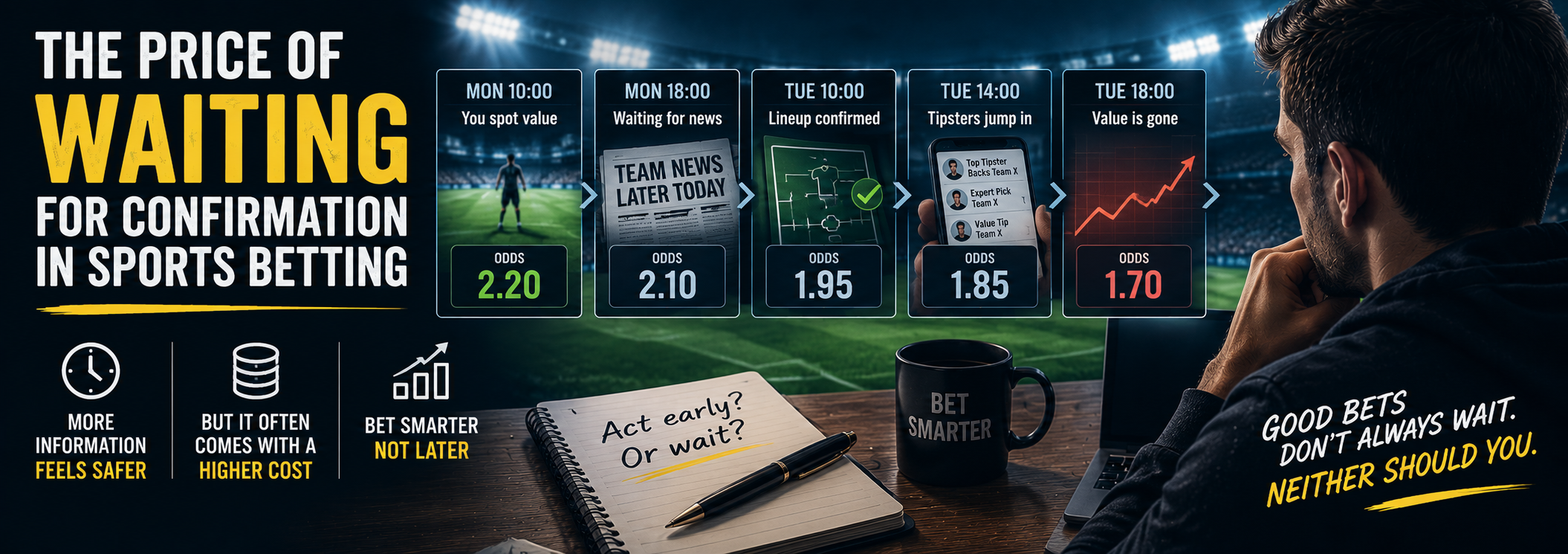
One of the hardest decisions in sports betting is knowing when to place a bet. You might identify a football team at odds of 2.20 that looks undervalued, but you're not completely convinced. The starting lineup isn't confirmed, respected tipsters haven't commented yet, and the market hasn't moved. So you wait.
Later, positive team news arrives. A few respected analysts back the same selection, and suddenly the odds fall to 1.90. You now have the confirmation you wanted—but the attractive price has disappeared. This is the hidden cost of waiting in sports betting. More information can reduce uncertainty, but the market often makes you pay for that certainty through worse odds.
Waiting often feels like the safer decision. Bettors want confirmed lineups, injury updates, market movement or agreement from other analysts before risking money. There is nothing inherently wrong with this. New information can genuinely change the probability of an outcome. The problem arises when bettors assume they can wait for certainty without sacrificing price.
If thousands of other bettors are waiting for the same information, they will react when it arrives. Odds can move quickly, especially when the news confirms what the market was already beginning to suspect. The bettor therefore faces a trade-off: better information versus better odds.
Suppose you estimate that a team has approximately a 50% chance of winning. Fair decimal odds based on that estimate would be around 2.00. The bookmaker offers 2.20. That could represent an attractive opportunity. But instead of entering, you wait until several tipsters recommend the same team. The market reacts and the odds fall to 1.80.
Your prediction may still be correct, but the bet has changed. At 2.20, you were receiving a price above your estimated fair value. At 1.80, you're accepting a price below it. This is why experienced bettors separate selection quality from price quality. A team can be a strong selection at one price and a poor bet at another.
Price deterioration is particularly important when following tipsters.
A tipster might publish a selection at 2.10. Early followers enter immediately and the market begins moving. Other betting communities notice the selection, more money arrives, and the price falls to 1.90.
A cautious follower may wait until several other tipsters agree before finally entering at 1.75. Everyone is technically backing the same outcome, but they are not making the same bet. If the selection wins, the difference may seem unimportant. Over hundreds of bets, however, consistently accepting worse prices can significantly affect long-term returns.
When evaluating tipsters, bettors should therefore pay attention not only to their results but also to whether the recommended odds are realistically available when followers receive the pick.
Betting early isn't automatically better either. Early prices can involve greater uncertainty. A key player might be injured, a manager could rotate the squad, weather conditions may change, or important information may not yet be public. Sometimes accepting slightly lower odds after receiving crucial confirmation is entirely reasonable.
The important question is what you're waiting for.
Waiting for information that could fundamentally change your probability estimate can be sensible. Waiting simply because you want more people to agree with you may provide psychological comfort without adding much analytical value. The objective isn't to bet as early as possible. It is to understand whether the information you're waiting for is worth the price you may lose.
One practical solution is to establish your minimum entry price before waiting. Suppose you identify a selection at 2.20 but decide that anything above 2.05 still offers sufficient value. You can wait for additional information while knowing exactly when the opportunity becomes unattractive. If the news arrives and the market moves to 2.10, you may still enter.
If it falls to 1.90, you pass. This prevents one of the most common betting mistakes: correctly identifying an opportunity but chasing it after the original value has disappeared. Being right about the team doesn't mean you should accept any price.
Confirmation feels valuable because it reduces uncertainty, but in efficient betting markets, useful information rarely comes for free. The longer you wait for lineups, market movement, expert agreement and other signals, the greater the chance that other bettors will receive the same information and adjust the price before you act. That doesn't mean betting early is always better. It means every bettor needs to balance information risk against price risk.
Sometimes waiting protects you from a bad bet. Other times, it turns a good bet into a bad price. The skill is knowing the difference.




Copyright © 2019 SportsTrade.io and all its predictions.
We're concerned about problem gambling. For most people, gambling is entertainment - a fun activity that can be enjoyed without harmful effect. But for some, it's not just a game - it's a serious problem that continues even after the fun has gone.
Compulsive gambling is not easily detected. The person with a gambling problem will often go to great lengths to cover up the problem and will appear to look all right, regardless of the consequences of their gambling.
Warning Signs. Some of the indicators that a person may be suffering from a gambling problem include:
Losing time from work or family due to gambling.
Repeated failed attempts to stop or control gambling.
Borrowing money to gamble or pay gambling debts.
Gambling to escape worry or trouble.
Neglecting the care of one's self or family in order to gamble.
Lying about the amount of time and money spent on gambling.
Gambling more money in an attempt to win back losses.
Selling or pawning personal possessions to get money to gamble.
Feelings of hopelessness, depression, or suicide as a result of gambling.
Remember that help is available. By reaching out to people who understand, you can find the help you need. You can visit the Gambler's Anonymous website here:http://www.gamblersanonymous.org/ or Responsible Gaming Council here: http://www.responsiblegambling.org/
This is a non-profit organization not affiliated with us in any way.
It is an offence for persons under the age of eighteen (18) to make use of the Website. If we are unable to confirm that you are 18 years old then we may suspend your account until such time that we are able to confirm your age. If you are subsequently proven to have been under 18 years of age at the time you made any transactions with us, then:
Your Account will be closed.
All transactions on your account will be made void, and all related funds deposited by you will be returned by the payment method used for the deposit of such funds, wherever practicable.
Sportstrade is committed to providing the best service possible. We want our member to have confidence in our platform, and that's why we offer a Credit Back Guarantee to all tips without profits. This program comes into effect on the 01 July 2015 ('Effective Date') and is offered to ensure that member who made tips purchase of any tips that ended with either lose, draw, cancelled or postponed game. The credits will automatically refund to your account the next day and the information will be available after login in the member dashboard and available in 'transaction history' tab