
Highlight
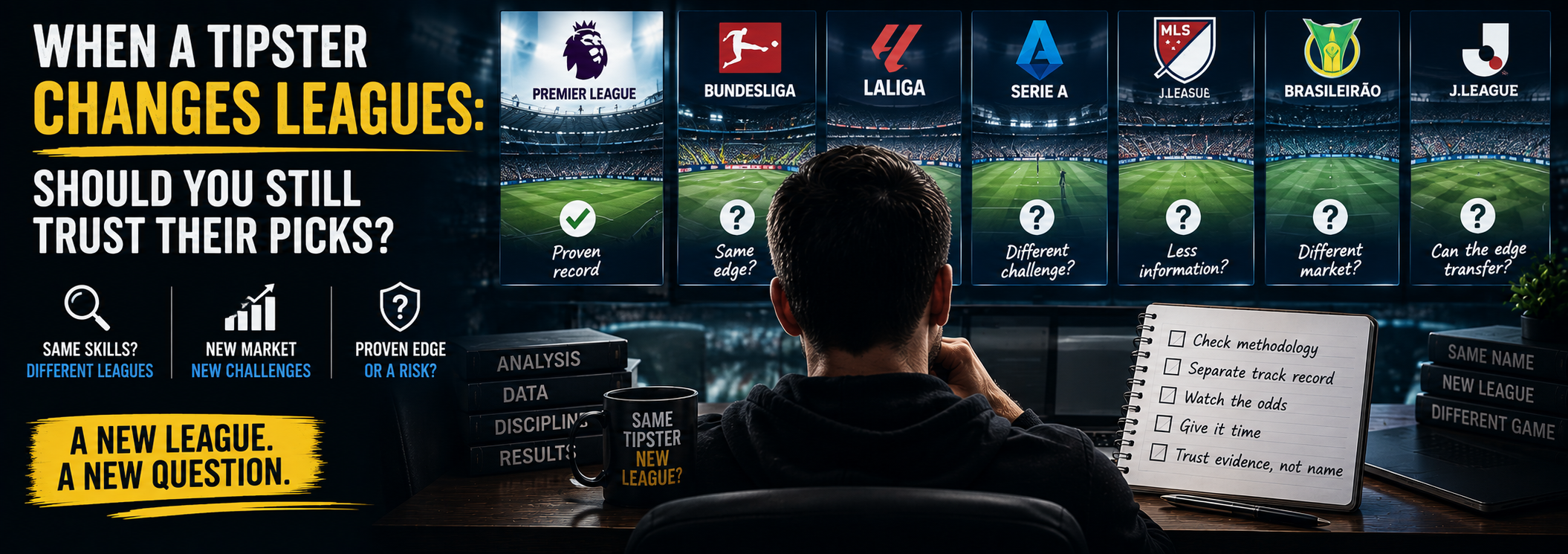
You have followed a Premier League tipster for two seasons. Their record is transparent, their analysis makes sense, and their results suggest they genuinely understand the market. Then the Premier League season ends. Suddenly, the same tipster starts posting picks from MLS, Brazil, Japan or smaller European leagues. The name is familiar, the confidence sounds the same, and the betting slips look no different.
But should you trust those selections in the same way?
Not necessarily. A tipster's track record doesn't automatically transfer from one league to another. Sports betting expertise is often far more specialised than followers realise, and understanding that distinction can prevent you from following a proven tipster into a market where they have no proven edge.
If someone consistently beats Premier League markets, that tells you something valuable about their ability in the Premier League. It doesn't automatically prove they can do the same in Serie A, MLS or the J-League. Different competitions have different characteristics. Tactical styles vary, information quality changes, squad rotation can be harder to predict, and some markets have significantly different levels of liquidity and efficiency.
A tipster may also have developed an advantage through years of following particular clubs, journalists, managers and statistical patterns. Moving into another league can remove much of that informational advantage. This doesn't mean the tipster suddenly becomes bad. It simply means the evidence supporting their original track record may no longer apply.
Before following a tipster into a new competition, ask why they were successful in the first place. Suppose their Premier League edge came from analysing tactical matchups and identifying situations where bookmakers underestimated certain playing styles. Some of that analytical skill may transfer reasonably well to other major European leagues. But imagine another tipster whose advantage comes from having exceptional knowledge of lower-league English football, including local injury information and squad changes that aren't widely reported. That advantage may have almost no relevance when they suddenly begin betting Brazilian football.
This is why a tipster's methodology matters as much as their historical ROI. If you understand where the edge comes from, you can make a better judgement about whether it is likely to travel.
One of the simplest ways to evaluate tipsters is to separate their results by competition. Imagine a tipster has produced a 9% ROI across 500 Premier League selections. That is useful historical information. If they have only made 20 MLS selections, however, there isn't enough evidence to assume the same performance exists there. The responsible approach is to treat the new league almost like a new tipster.
Track the selections separately. Look at the prices they obtain, Closing Line Value (CLV), ROI and consistency over a meaningful sample. Don't allow hundreds of successful bets from an unrelated competition to make a small new sample look more reliable than it really is. A tipster's overall record can hide major differences between markets.
This issue becomes especially common during the football off-season. Tipsters who normally specialise in major European leagues suddenly need new content. Some move into Scandinavian football, MLS, South America, international friendlies or other summer competitions. There is nothing inherently wrong with expanding into new markets. Skilled analysts can research new competitions and develop additional expertise.
The warning sign is when there is no evidence of that transition. If someone spent an entire season presenting themselves as a Premier League specialist and suddenly begins releasing confident picks from six unfamiliar competitions, followers should ask whether genuine research has expanded—or whether the tipster simply wants to maintain daily betting volume. A professional bettor doesn't need to have a bet every day. Neither does a professional tipster.
Results aren't the only way to judge whether a tipster understands a new league. Watch what happens to their prices. If a tipster consistently recommends selections at 2.10 that later close around 1.90, that can provide evidence that they are identifying prices the wider market eventually considers too high. This doesn't prove future profitability, but persistent positive CLV can be a useful indicator that their process is working.
If their new-league selections regularly move against them, or their quoted odds are difficult for followers to obtain, the new strategy deserves closer examination. This is particularly important when moving from major competitions into smaller markets, where liquidity can be lower and prices can move much faster.
None of this means you should automatically stop following a tipster whenever they change leagues. Some skills genuinely transfer. Understanding probability, price, tactical analysis, modelling and market behaviour can be useful across many competitions. A sophisticated quantitative model may even be specifically designed to analyse dozens of leagues using the same framework.
The mistake is assuming transferability instead of testing it. Give the new selections their own sample. Reduce your confidence until evidence develops. If you normally stake one unit on the tipster's established market, you might simply observe the new league first rather than immediately treating it as equivalent. Trust should follow evidence—not the tipster's username.
A tipster's reputation is often built in a particular environment. Their knowledge, data, contacts, modelling and understanding of market behaviour may be especially strong in one league but ordinary elsewhere. When that tipster moves into a new competition, their previous record remains relevant evidence of their general ability—but it shouldn't automatically become proof of expertise in the new market.
Look at where their original edge came from. Separate results by league. Monitor their prices and give the new strategy time to establish its own record. A great Premier League tipster may become a great MLS tipster too. But until the evidence exists, those are two different claims.



Copyright © 2019 SportsTrade.io and all its predictions.
We're concerned about problem gambling. For most people, gambling is entertainment - a fun activity that can be enjoyed without harmful effect. But for some, it's not just a game - it's a serious problem that continues even after the fun has gone.
Compulsive gambling is not easily detected. The person with a gambling problem will often go to great lengths to cover up the problem and will appear to look all right, regardless of the consequences of their gambling.
Warning Signs. Some of the indicators that a person may be suffering from a gambling problem include:
Losing time from work or family due to gambling.
Repeated failed attempts to stop or control gambling.
Borrowing money to gamble or pay gambling debts.
Gambling to escape worry or trouble.
Neglecting the care of one's self or family in order to gamble.
Lying about the amount of time and money spent on gambling.
Gambling more money in an attempt to win back losses.
Selling or pawning personal possessions to get money to gamble.
Feelings of hopelessness, depression, or suicide as a result of gambling.
Remember that help is available. By reaching out to people who understand, you can find the help you need. You can visit the Gambler's Anonymous website here:http://www.gamblersanonymous.org/ or Responsible Gaming Council here: http://www.responsiblegambling.org/
This is a non-profit organization not affiliated with us in any way.
It is an offence for persons under the age of eighteen (18) to make use of the Website. If we are unable to confirm that you are 18 years old then we may suspend your account until such time that we are able to confirm your age. If you are subsequently proven to have been under 18 years of age at the time you made any transactions with us, then:
Your Account will be closed.
All transactions on your account will be made void, and all related funds deposited by you will be returned by the payment method used for the deposit of such funds, wherever practicable.
Sportstrade is committed to providing the best service possible. We want our member to have confidence in our platform, and that's why we offer a Credit Back Guarantee to all tips without profits. This program comes into effect on the 01 July 2015 ('Effective Date') and is offered to ensure that member who made tips purchase of any tips that ended with either lose, draw, cancelled or postponed game. The credits will automatically refund to your account the next day and the information will be available after login in the member dashboard and available in 'transaction history' tab