
Highlight
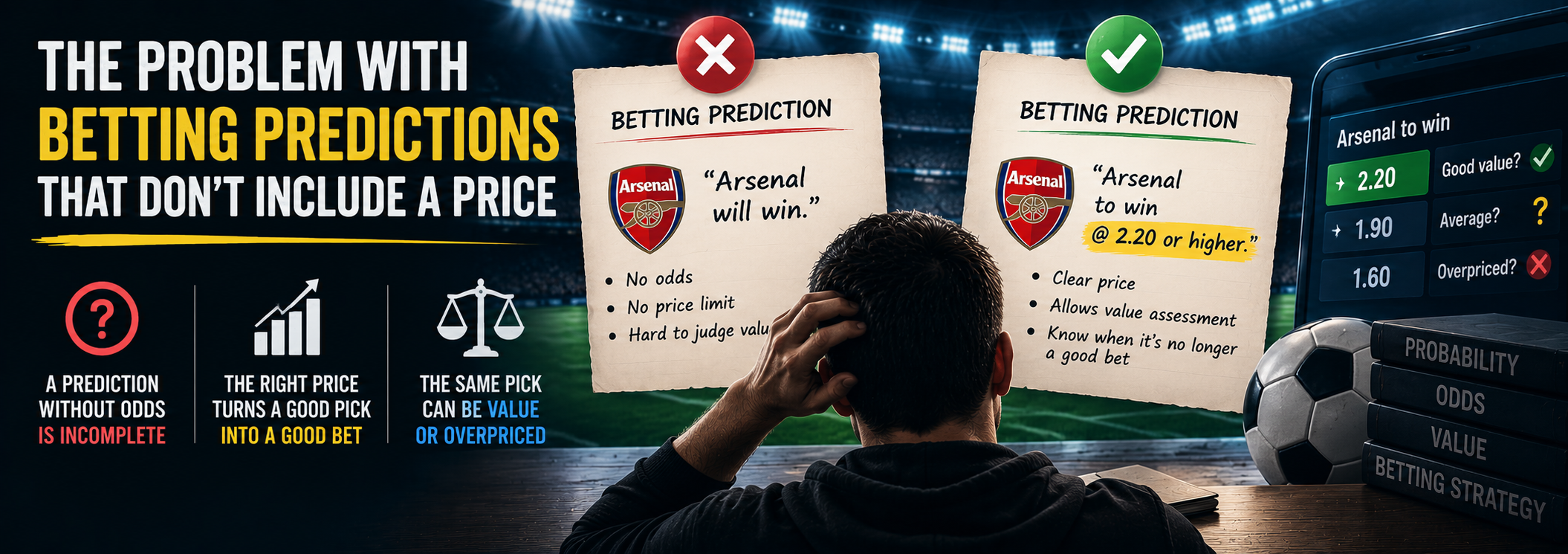
"Arsenal will win."
"Over 2.5 Goals looks strong."
"This is my best bet of the weekend."
Sports betting predictions like these appear everywhere. They may include detailed statistics, tactical analysis and convincing arguments, but many leave out one of the most important pieces of information: the price. In betting, predicting the correct outcome is only part of the job. The odds determine whether that prediction is actually worth betting on. A team can be highly likely to win and still be a terrible bet at the wrong price. Likewise, an underdog can be unlikely to win but still offer value if the odds are sufficiently generous. Without knowing the price, a betting prediction is incomplete.
Suppose an analyst believes a football team has a 60% chance of winning. That is a prediction about probability. Now consider two bookmakers. One offers odds of 1.40, while another offers 1.90. The prediction hasn't changed, but the betting opportunity has. Decimal odds of 1.40 imply a probability of roughly 71%, while 1.90 implies approximately 53%. If your estimate remains at 60%, the first price looks unattractive while the second may offer value. This is why simply saying "Team A will win" isn't enough. Bettors need to know at what price the analyst believes Team A becomes worth backing. Without that information, there is no way to properly evaluate the recommendation.
Bettors sometimes assume that if an outcome is very likely, it must be a good bet. Imagine a dominant home team facing one of the weakest sides in the league. Most analysts expect the favourite to win, and they may be correct. But if the market has already priced that advantage aggressively, there may be little or no value left. A bettor who estimates the favourite's true winning probability at 75% should not automatically back it simply because it is "very likely to win." If the available odds imply an 85% probability, the market is demanding too high a price for that confidence. The same principle applies to goals, handicaps, player props and almost every other betting market. The question is never simply, "Will this happen?" It should be, "How often will this happen compared with what the odds imply?"
Price becomes particularly important when evaluating tipsters. Suppose a tipster publishes a selection at 2.10. Followers immediately bet it, and the odds fall to 1.95. By the time someone discovers the pick several hours later, the market offers only 1.75. Technically, everyone is backing the same selection. Economically, however, they are placing very different bets. If the tipster consistently identifies value at the original price, their published record may be profitable. A follower repeatedly entering at significantly shorter odds might achieve very different long-term results. This is why credible tipster records should include the odds available when selections were released. A win-loss record without prices tells only part of the story. A tipster winning 60% of their bets could be highly profitable, roughly break-even or losing money depending on the average odds they take.
Recreational bettors naturally focus on predicting winners. Professional betting requires a slightly different mindset. Instead of asking which team will win, start thinking about what probability you would assign to each outcome. If you believe a team has a 40% chance of winning, fair decimal odds would be approximately 2.50. If the market offers 3.00, there may be an opportunity. At 2.10, the same team might not be worth betting. This way of thinking also explains why professional bettors can back teams they don't necessarily expect to win. An underdog may have only a 30% chance of victory, meaning it will lose most of the time. But if the available odds significantly underestimate that 30% probability, the bet can still make sense from an expected-value perspective. The objective isn't to predict every match correctly. It is to consistently identify situations where your estimated probability differs favourably from the market price.
One useful habit is to attach a minimum acceptable price to every selection.
Instead of saying:
"Back Team A."
A more useful recommendation would be:
"Back Team A at 2.00 or higher."
That small addition completely changes the quality of the information. If the market moves to 1.80, followers know that the original opportunity may no longer exist. They aren't forced to chase the selection simply because they still agree with the prediction. This is particularly important in fast-moving markets where a strong tip can attract enough money to change the odds within minutes. A betting recommendation should therefore describe not only what to bet, but also when the price stops being attractive.
Sports betting predictions are easy to produce. Pick a winner, provide some statistics and explain why the selection looks strong. But betting isn't simply a prediction game. It is a pricing game.
Without odds, you cannot properly calculate implied probability, expected value or whether the opportunity still exists after the market moves. That's why "Team A will win" is not a complete betting recommendation. The more useful statement is: "Team A has a better chance of winning than these odds suggest." Because in sports betting, being right about the outcome is important. Being right about the price is what determines whether the bet was worth making.



Copyright © 2019 SportsTrade.io and all its predictions.
We're concerned about problem gambling. For most people, gambling is entertainment - a fun activity that can be enjoyed without harmful effect. But for some, it's not just a game - it's a serious problem that continues even after the fun has gone.
Compulsive gambling is not easily detected. The person with a gambling problem will often go to great lengths to cover up the problem and will appear to look all right, regardless of the consequences of their gambling.
Warning Signs. Some of the indicators that a person may be suffering from a gambling problem include:
Losing time from work or family due to gambling.
Repeated failed attempts to stop or control gambling.
Borrowing money to gamble or pay gambling debts.
Gambling to escape worry or trouble.
Neglecting the care of one's self or family in order to gamble.
Lying about the amount of time and money spent on gambling.
Gambling more money in an attempt to win back losses.
Selling or pawning personal possessions to get money to gamble.
Feelings of hopelessness, depression, or suicide as a result of gambling.
Remember that help is available. By reaching out to people who understand, you can find the help you need. You can visit the Gambler's Anonymous website here:http://www.gamblersanonymous.org/ or Responsible Gaming Council here: http://www.responsiblegambling.org/
This is a non-profit organization not affiliated with us in any way.
It is an offence for persons under the age of eighteen (18) to make use of the Website. If we are unable to confirm that you are 18 years old then we may suspend your account until such time that we are able to confirm your age. If you are subsequently proven to have been under 18 years of age at the time you made any transactions with us, then:
Your Account will be closed.
All transactions on your account will be made void, and all related funds deposited by you will be returned by the payment method used for the deposit of such funds, wherever practicable.
Sportstrade is committed to providing the best service possible. We want our member to have confidence in our platform, and that's why we offer a Credit Back Guarantee to all tips without profits. This program comes into effect on the 01 July 2015 ('Effective Date') and is offered to ensure that member who made tips purchase of any tips that ended with either lose, draw, cancelled or postponed game. The credits will automatically refund to your account the next day and the information will be available after login in the member dashboard and available in 'transaction history' tab