
Highlight
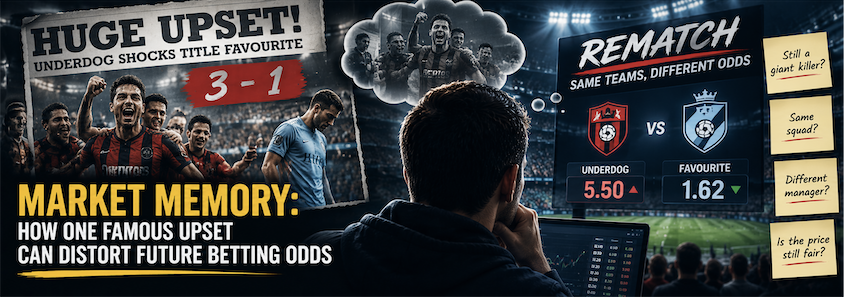
Some sporting results are difficult to forget. A massive underdog defeats a title favourite, a relegation candidate shocks the league leader, or an unfancied team produces a famous cup upset that dominates headlines for days. The result becomes part of the story surrounding both teams. When they meet again, bettors remember exactly what happened. That memory can influence betting decisions far more than it should. Sports betting markets are supposed to price future probabilities, but bettors are human. Dramatic events are easier to remember than ordinary ones, which means one famous upset can sometimes influence expectations long after the circumstances that created it have disappeared. For disciplined bettors, the important question isn't "What happened last time?" but "How relevant is what happened last time to today's price?"
A routine 2-0 victory by a heavy favourite rarely becomes memorable. A 20.00 underdog winning the same fixture can be discussed for years. This is partly because unexpected events attract attention. They generate headlines, highlights and social media discussion. When bettors later evaluate the same teams, that famous result is much easier to recall than dozens of more ordinary matches. The danger is that memorability can be mistaken for predictive importance.
Imagine an underdog defeated a major club 3-1 last season. When the fixture returns, bettors may hesitate to back the favourite because they remember exactly what happened before. But perhaps the underdog scored from three of its four shots while the favourite dominated most of the match. Maybe important players were missing. Perhaps the favourite had played a European fixture three days earlier. The final score remains memorable even when the circumstances behind it are forgotten.
Major upsets can also influence how bettors perceive the underdog. Before the famous victory, the team may have been viewed as ordinary. Afterwards, it becomes known as a "giant killer" or a side that "always performs against big teams." That reputation can survive far longer than the evidence supporting it.
If enough bettors begin treating the team differently, demand can influence the odds. An underdog that once attracted little attention may receive significantly more backing in future high-profile fixtures simply because bettors remember what it achieved previously. The team hasn't necessarily become stronger. Its market reputation has changed This creates an important distinction between what a team has achieved and what the current odds already assume about it.
Market memory becomes even more powerful when combined with head-to-head statistics. Suppose Team B has beaten Team A in three of their previous five meetings. That statistic looks meaningful, particularly if one of those victories was a famous upset. But those matches may have involved different managers, different players, different tactical systems and completely different circumstances.
Historical meetings can provide useful context, but bettors should be careful about assigning predictive value simply because the same club names appear on the fixture list. The further conditions move away from those previous matches, the less relevant the old results may become. A football club is not a fixed entity. Squads change. Managers change. Playing styles change. What happened two seasons ago may tell you considerably less about today's match than current team strength and price.
Market memory doesn't only create excessive confidence in underdogs. It can also create unnecessary fear around favourites. After watching a powerful team suffer a shocking defeat, bettors may become reluctant to back it in similar situations. The emotional impact of the loss can make another upset feel more likely than it actually is. This is closely related to recency bias and availability bias: events that are recent or memorable can receive too much weight when people estimate probability.
The correct response isn't to ignore previous upsets. Instead, bettors should examine whether the result revealed something repeatable. Did the favourite consistently struggle against a particular tactical setup? Was there a structural weakness that still exists? Did the underdog expose a problem that other opponents subsequently exploited? If so, the old result may contain useful information. If the upset depended largely on unusual finishing, a red card, an injury or other one-off circumstances, its predictive value may be much smaller.
The easiest way to avoid market memory is to stop asking whether the famous upset could happen again. Of course it could. Underdogs win every week. The better question is whether the current odds accurately represent the probability of it happening again.
Suppose an underdog won the previous meeting when priced at 8.00. In the rematch, public confidence and media attention help shorten the team to 5.50. That doesn't necessarily make the underdog a better bet. In fact, the famous victory may have contributed to making the price less attractive. Conversely, if bettors overreact to a favourite's previous failure and the market becomes unusually generous, the value may exist on the favourite instead. This is why sports traders should evaluate today's information independently before looking too closely at historical narratives.
Previous matches can still be useful. The mistake is treating the result itself as the lesson. Instead, investigate why the upset happened. If the same tactical matchup remains, the same core players are involved and the market appears to be ignoring a repeatable weakness, the previous result may deserve serious attention.
If almost everything has changed, the famous scoreline may be little more than an interesting piece of history. Good betting analysis doesn't forget the past. It simply refuses to let the most memorable part of the past dominate the future.
Famous upsets are powerful because they create stories bettors remember. Those stories can shape expectations, influence confidence and sometimes affect how future markets are priced. But betting markets don't pay for remembering dramatic results. They reward correctly assessing probabilities at today's odds.
When two teams meet again after a famous upset, don't simply ask whether history can repeat itself. Examine what caused the original result, determine whether those conditions still exist and compare today's probability with today's price. The previous upset may contain valuable information. Or it may simply be a memory that the market is charging you to believe.



Copyright © 2019 SportsTrade.io and all its predictions.
We're concerned about problem gambling. For most people, gambling is entertainment - a fun activity that can be enjoyed without harmful effect. But for some, it's not just a game - it's a serious problem that continues even after the fun has gone.
Compulsive gambling is not easily detected. The person with a gambling problem will often go to great lengths to cover up the problem and will appear to look all right, regardless of the consequences of their gambling.
Warning Signs. Some of the indicators that a person may be suffering from a gambling problem include:
Losing time from work or family due to gambling.
Repeated failed attempts to stop or control gambling.
Borrowing money to gamble or pay gambling debts.
Gambling to escape worry or trouble.
Neglecting the care of one's self or family in order to gamble.
Lying about the amount of time and money spent on gambling.
Gambling more money in an attempt to win back losses.
Selling or pawning personal possessions to get money to gamble.
Feelings of hopelessness, depression, or suicide as a result of gambling.
Remember that help is available. By reaching out to people who understand, you can find the help you need. You can visit the Gambler's Anonymous website here:http://www.gamblersanonymous.org/ or Responsible Gaming Council here: http://www.responsiblegambling.org/
This is a non-profit organization not affiliated with us in any way.
It is an offence for persons under the age of eighteen (18) to make use of the Website. If we are unable to confirm that you are 18 years old then we may suspend your account until such time that we are able to confirm your age. If you are subsequently proven to have been under 18 years of age at the time you made any transactions with us, then:
Your Account will be closed.
All transactions on your account will be made void, and all related funds deposited by you will be returned by the payment method used for the deposit of such funds, wherever practicable.
Sportstrade is committed to providing the best service possible. We want our member to have confidence in our platform, and that's why we offer a Credit Back Guarantee to all tips without profits. This program comes into effect on the 01 July 2015 ('Effective Date') and is offered to ensure that member who made tips purchase of any tips that ended with either lose, draw, cancelled or postponed game. The credits will automatically refund to your account the next day and the information will be available after login in the member dashboard and available in 'transaction history' tab