
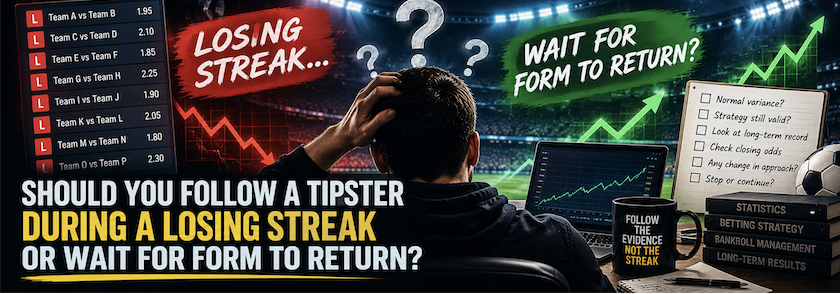
Every sports bettor who follows tipsters eventually faces the same uncomfortable situation. A tipster who has delivered consistent profits suddenly loses six, eight or even ten selections in a row. Their confidence appears unchanged, but their followers are beginning to question whether the winning strategy has stopped working. Some bettors immediately stop following, hoping to return when the tipster starts winning again. Others continue placing bets, believing that a recovery must be around the corner.
Both approaches can be dangerous when driven by emotion rather than evidence. A losing streak doesn't automatically mean a tipster has lost their edge, just as a winning streak doesn't prove that an edge exists. The challenge is determining whether recent losses are normal variance or evidence of a genuine decline in performance.
Sports betting involves probability, not certainty. Even a tipster with a genuine long-term advantage will experience periods when results go against expectations. Consider a tipster whose selections have a 55% chance of winning on average. That still means approximately 45% of their bets are expected to lose. Over hundreds of selections, several consecutive losses are entirely possible, even if the underlying strategy remains profitable at the prices obtained. The problem is that bettors often evaluate tipsters based on their most recent results. A strong month creates confidence, while a poor week generates doubts. This tendency to place excessive importance on recent performance can lead followers to abandon otherwise sound strategies at precisely the wrong moment.
However, not every losing streak should be dismissed as bad luck. Markets change, strategies become less effective, and tipsters sometimes lose the discipline that originally made them successful. The key is understanding which situation you're dealing with.
Waiting until a tipster starts winning again sounds sensible. After all, why risk money during a losing period when you could simply return once results improve?
The problem is that nobody knows when the recovery will begin. Imagine a tipster loses eight consecutive selections. You decide to stop following until they produce five winners. Unfortunately, the next five selections win, and you miss the entire recovery. Once you return, the tipster experiences another ordinary losing sequence. You've effectively followed the losses while missing the wins.
This behaviour is common among bettors who constantly enter and exit tipster subscriptions based on short-term performance. Instead of evaluating the underlying strategy, they chase whichever tipster appears to be in form.
There is also no mathematical rule suggesting that a tipster becomes more likely to win simply because they have recently lost. Assuming a recovery is guaranteed is another mistake, commonly associated with the gambler's fallacy.
A better approach is to investigate whether the tipster's decision-making process has changed. Suppose a tipster has historically specialised in Asian Handicap markets within the Premier League. During a recent losing streak, they continue selecting similar markets, following the same analytical process and obtaining competitive prices. Their results may simply reflect normal variance. Now consider another tipster who suddenly increases stakes, begins recommending unfamiliar leagues and starts chasing high-odds accumulators after several losses. That behaviour suggests a more serious problem than temporary bad luck.
Closing Line Value (CLV) can provide additional insight. If a tipster consistently recommends selections at 2.10 that later close at 1.95, it may indicate that their prices are competitive with the closing market. However, CLV is not proof of profitability, and its usefulness depends on the quality of the market being measured. The most useful evaluation combines historical ROI, sample size, available odds, market specialisation and consistency of strategy rather than focusing entirely on the latest results.
There are legitimate reasons to stop following a tipster, but a short losing streak alone is rarely sufficient evidence. A sustained deterioration in performance deserves attention, particularly when accompanied by negative CLV, unexplained changes in strategy or a lack of transparency. Tipsters who delete losing selections, manipulate historical records or advertise unrealistic guarantees should also raise immediate concerns. Your own financial situation matters just as much. Even if a tipster's strategy remains credible, continuing to follow may be inappropriate if the losses exceed your planned bankroll limits or risk tolerance.
Importantly, you don't have to choose between blindly following every selection and permanently abandoning the tipster. You can pause real-money betting, continue tracking their selections and reassess the strategy using a larger sample. This allows you to collect evidence without exposing additional capital during a period of uncertainty.
The worst time to decide how to handle losses is when you're already frustrated by them. Before following a tipster, establish how you will evaluate their performance. Decide what historical evidence you require, which markets you are comfortable following and how much of your bankroll you are prepared to risk.
You should also determine what would cause you to review or suspend the strategy. These conditions might include meaningful changes in betting methodology, deteriorating price quality or losses exceeding a predetermined risk limit. Having these rules in place reduces the temptation to make emotional decisions after every winning or losing run. Remember that following a tipster is not simply about trusting their next prediction. It is about evaluating whether their overall process remains credible over time.
A losing streak doesn't necessarily mean a tipster has become unreliable, and waiting for winning form to return doesn't guarantee better results. Both following and stopping involve uncertainty. The smartest approach is to evaluate the quality of the strategy rather than reacting to recent outcomes. Historical performance, market expertise, pricing discipline and transparency provide a more meaningful picture than a handful of losing bets.
If the evidence remains strong, a losing streak may be ordinary variance. If the underlying process has deteriorated, stepping away may be justified. Don't follow a tipster simply because they're winning, and don't abandon one simply because they're losing. Follow the evidence, not the streak.




Copyright © 2019 SportsTrade.io and all its predictions.
We're concerned about problem gambling. For most people, gambling is entertainment - a fun activity that can be enjoyed without harmful effect. But for some, it's not just a game - it's a serious problem that continues even after the fun has gone.
Compulsive gambling is not easily detected. The person with a gambling problem will often go to great lengths to cover up the problem and will appear to look all right, regardless of the consequences of their gambling.
Warning Signs. Some of the indicators that a person may be suffering from a gambling problem include:
Losing time from work or family due to gambling.
Repeated failed attempts to stop or control gambling.
Borrowing money to gamble or pay gambling debts.
Gambling to escape worry or trouble.
Neglecting the care of one's self or family in order to gamble.
Lying about the amount of time and money spent on gambling.
Gambling more money in an attempt to win back losses.
Selling or pawning personal possessions to get money to gamble.
Feelings of hopelessness, depression, or suicide as a result of gambling.
Remember that help is available. By reaching out to people who understand, you can find the help you need. You can visit the Gambler's Anonymous website here:http://www.gamblersanonymous.org/ or Responsible Gaming Council here: http://www.responsiblegambling.org/
This is a non-profit organization not affiliated with us in any way.
It is an offence for persons under the age of eighteen (18) to make use of the Website. If we are unable to confirm that you are 18 years old then we may suspend your account until such time that we are able to confirm your age. If you are subsequently proven to have been under 18 years of age at the time you made any transactions with us, then:
Your Account will be closed.
All transactions on your account will be made void, and all related funds deposited by you will be returned by the payment method used for the deposit of such funds, wherever practicable.
Sportstrade is committed to providing the best service possible. We want our member to have confidence in our platform, and that's why we offer a Credit Back Guarantee to all tips without profits. This program comes into effect on the 01 July 2015 ('Effective Date') and is offered to ensure that member who made tips purchase of any tips that ended with either lose, draw, cancelled or postponed game. The credits will automatically refund to your account the next day and the information will be available after login in the member dashboard and available in 'transaction history' tab