Following multiple sports betting tipsters seems like a sensible strategy. If one expert recommends a selection, checking another opinion should help confirm whether the bet is worth taking. After all, more information should lead to better decisions, right?
Not necessarily.
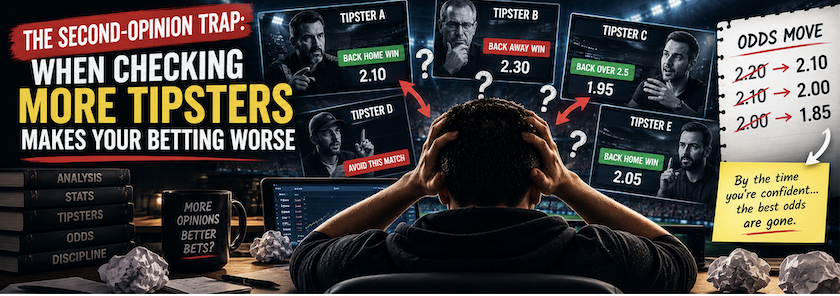
Many bettors fall into what can be called the second-opinion trap, where constantly checking additional tipsters creates confusion, delays decisions and reduces the value of otherwise promising betting opportunities. Instead of improving their analysis, bettors become dependent on external confirmation. They start questioning their original judgement, chasing popular selections and entering markets after the best odds have disappeared. The problem isn't following multiple tipsters. It's failing to understand when additional opinions stop providing useful information.
Sports betting involves uncertainty, and uncertainty naturally creates discomfort. Even after researching a match thoroughly, bettors may hesitate because they know their prediction could still be wrong. Checking another tipster provides reassurance. If that expert agrees, confidence increases. If a third analyst also recommends the same selection, the bet suddenly feels much safer.
This behaviour is closely related to confirmation bias, where people favour information that supports their existing beliefs. Rather than objectively evaluating new evidence, bettors may continue searching until they find enough agreement to justify the decision they already wanted to make. The danger is that confidence can increase without any meaningful improvement in the actual probability assessment.
Five tipsters recommending the same outcome doesn't automatically make it five times more likely to happen, especially when those analysts rely on similar statistics, prediction models or market signals.
While agreement creates confidence, disagreement can have the opposite effect. Imagine you've identified a football selection at odds of 2.10. Your analysis suggests the price offers value, and the first tipster you consult agrees. However, another analyst recommends the opposing team, while a third suggests avoiding the match entirely. Suddenly, a decision that originally appeared straightforward becomes complicated.
You begin searching for additional opinions, hoping to resolve the disagreement. Unfortunately, every new prediction introduces another argument, statistic or interpretation. This can lead to analysis paralysis, where bettors spend so much time comparing conflicting opinions that they struggle to make any decision at all.
Professional betting requires accepting uncertainty. No amount of research can guarantee an outcome, and continuously seeking confirmation doesn't necessarily improve prediction accuracy.
One of the biggest consequences of excessive confirmation-seeking is poor entry timing. Suppose a respected tipster identifies value at odds of 2.20. Instead of acting on the available information, you wait for other analysts to publish their predictions.
As more tipsters recommend the same selection, betting activity increases and the odds shorten to 2.00, then 1.85. By the time you feel confident enough to enter, the original value may have disappeared. This creates an important contradiction: the more confirmation you receive, the worse the available betting price may become.
A selection that offered positive expected value at 2.20 doesn't necessarily remain attractive at 1.85. Even if the prediction eventually wins, repeatedly accepting shorter odds can significantly damage long-term profitability. Of course, waiting isn't always wrong. Additional information may reveal a genuine problem with your original analysis. The important distinction is whether you're waiting for meaningful evidence or simply emotional reassurance.
Another overlooked problem is that different tipsters often rely on the same underlying information. Several analysts may use identical statistical databases, follow the same injury reports or react to the same odds movements. Others may indirectly repeat selections originally published by influential betting accounts. This creates the appearance of widespread agreement without providing genuinely independent analysis.
For example, five tipsters might all recommend Over 2.5 Goals because they rely on the same Expected Goals model. Their agreement doesn't necessarily represent five separate confirmations. It may simply reflect one shared assumption. Independent opinions become more valuable when they come from different analytical approaches. A statistical modeller, a tactical specialist and someone with reliable local team information may contribute genuinely different perspectives. The objective should be to evaluate the quality and independence of the evidence rather than count how many people agree.
The solution isn't to stop checking other tipsters entirely. Additional opinions can identify weaknesses in your analysis, highlight overlooked information and challenge assumptions. However, bettors should establish their own assessment before seeking external confirmation. This creates a reference point against which new information can be evaluated.
Instead of asking whether another tipster agrees with your selection, examine what they contribute. Do they provide new injury information? Have they identified a tactical mismatch? Are they using a different probability model? If the opinion introduces genuinely useful evidence, reconsider your estimate. If it simply repeats information you already know, it may add little value. It also helps to establish a minimum acceptable price before consulting additional sources. If the market moves below that threshold, you can walk away rather than chase a selection simply because several experts now support it.
Most importantly, don't assume that more opinions automatically produce better decisions. Sometimes one well-researched analysis is more useful than ten predictions offering little independent evidence.
Checking multiple tipsters can be valuable, but only when the additional opinions improve your understanding of the betting opportunity. The second-opinion trap occurs when bettors confuse agreement with accuracy, seek endless reassurance and allow confirmation-seeking to interfere with pricing discipline.
Successful sports trading isn't about finding the largest number of experts who support your prediction. It's about evaluating independent evidence, estimating probability and deciding whether the available odds justify the risk. The next time you feel tempted to check another five tipsters, ask yourself whether you're looking for new information—or simply someone to agree with you.
Sometimes the smartest betting decision is knowing when you've researched enough.




Copyright © 2019 SportsTrade.io and all its predictions.
We're concerned about problem gambling. For most people, gambling is entertainment - a fun activity that can be enjoyed without harmful effect. But for some, it's not just a game - it's a serious problem that continues even after the fun has gone.
Compulsive gambling is not easily detected. The person with a gambling problem will often go to great lengths to cover up the problem and will appear to look all right, regardless of the consequences of their gambling.
Warning Signs. Some of the indicators that a person may be suffering from a gambling problem include:
Losing time from work or family due to gambling.
Repeated failed attempts to stop or control gambling.
Borrowing money to gamble or pay gambling debts.
Gambling to escape worry or trouble.
Neglecting the care of one's self or family in order to gamble.
Lying about the amount of time and money spent on gambling.
Gambling more money in an attempt to win back losses.
Selling or pawning personal possessions to get money to gamble.
Feelings of hopelessness, depression, or suicide as a result of gambling.
Remember that help is available. By reaching out to people who understand, you can find the help you need. You can visit the Gambler's Anonymous website here:http://www.gamblersanonymous.org/ or Responsible Gaming Council here: http://www.responsiblegambling.org/
This is a non-profit organization not affiliated with us in any way.
It is an offence for persons under the age of eighteen (18) to make use of the Website. If we are unable to confirm that you are 18 years old then we may suspend your account until such time that we are able to confirm your age. If you are subsequently proven to have been under 18 years of age at the time you made any transactions with us, then:
Your Account will be closed.
All transactions on your account will be made void, and all related funds deposited by you will be returned by the payment method used for the deposit of such funds, wherever practicable.
Sportstrade is committed to providing the best service possible. We want our member to have confidence in our platform, and that's why we offer a Credit Back Guarantee to all tips without profits. This program comes into effect on the 01 July 2015 ('Effective Date') and is offered to ensure that member who made tips purchase of any tips that ended with either lose, draw, cancelled or postponed game. The credits will automatically refund to your account the next day and the information will be available after login in the member dashboard and available in 'transaction history' tab