
Highlight
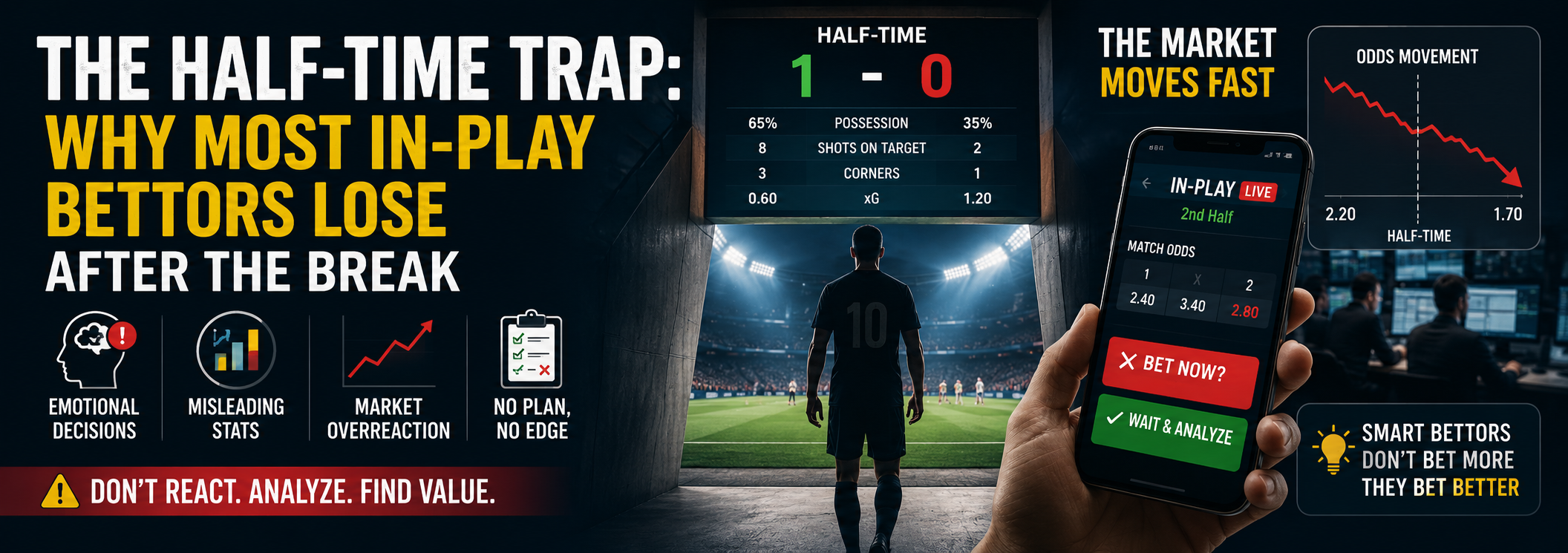
Half-time is one of the busiest moments in live sports betting.
The first 45 minutes are over. Statistics flood the screen. Commentators begin analysing the game. Social media is filled with predictions about what will happen next.
For many bettors, it feels like the perfect time to place a wager. After all, you've already watched half the match. Surely you now have more information than you did before kickoff.
Surprisingly, this confidence is exactly why so many in-play bettors lose money after the break. The problem isn't a lack of information. It's what bettors do with it.
Half-time gives bettors something they didn't have before the match started—context.
You know:
The current score
Possession statistics
Shots on target
Corners
Expected Goals (xG)
Player performances
This creates the illusion that predicting the second half should now be easier. But here's what many bettors forget.
Bookmakers have exactly the same information. In fact, they often have far more. Professional traders are updating models in real time, incorporating thousands of data points every second. By the time you place your bet, the market has already adjusted to what happened during the first half. You're rarely discovering something the market hasn't already priced in.
One of the biggest mistakes in live betting is assuming the score tells the whole story. Imagine two matches.
Match A:
Team A leads 1-0.
They have dominated possession, created numerous chances, and deserve the lead.
Match B:
Team A also leads 1-0.
They scored from their only shot while spending most of the half defending.
The score is identical. The performances are completely different. Yet many bettors treat both matches the same simply because of the scoreboard. Sharp traders look beyond goals. They analyse how the match is unfolding, not just what the score says.
Half-time also creates emotional decision-making. Perhaps your pre-match bet is losing.
You convince yourself:
"They'll definitely come back."
Or maybe your team has just conceded before the whistle.
Now you're eager to recover your losses by betting on the second half.
These decisions often have little to do with value. They're emotional reactions disguised as strategy. Professional traders understand that every second-half market should be evaluated independently of what happened to their previous bet. The market doesn't owe you a comeback.
Modern betting platforms display dozens of live statistics.
Possession.
Shots.
Corners.
Attacks.
Dangerous attacks.
Expected Goals.
These numbers are useful—but only when interpreted correctly.
For example, a team may have:
65% possession
15 shots
Only 0.60 xG
This suggests they're controlling the ball but creating very few quality chances.
Meanwhile, the opponent may have:
35% possession
5 shots
1.20 xG
They're creating fewer chances—but far better ones. Looking at one statistic in isolation often leads bettors to completely wrong conclusions.
Half-time is also when public opinion becomes strongest. If a favourite is losing, thousands of bettors rush to back them in the second half. If an underdog is leading, many immediately expect a collapse. These emotional reactions can temporarily push prices away from fair value.
Sometimes the market overreacts.
Sometimes it underreacts.
The opportunity isn't betting because something happened. The opportunity is identifying when the market has priced that event incorrectly.
This is the lesson many experienced traders eventually learn. Watching a match doesn't create an obligation to bet on it. Professional bettors skip countless second-half opportunities because they don't see enough value. That's difficult for recreational bettors to accept.
After watching an entire first half, doing nothing feels unproductive. In reality, patience is often the most profitable decision. Every skipped bad bet protects your bankroll just as much as every winning one grows it.
Instead of asking:
"Who will win the second half?"
Ask yourself:
Has the market already adjusted?
Is the current price still offering value?
Am I reacting emotionally?
Do the underlying statistics support the scoreline?
Would I place this bet if I had no pre-match position?
These questions slow your thinking and reduce impulsive decisions. Over time, they become one of the biggest advantages you can develop in live betting.
Half-time feels like an opportunity because you know more than you did before kickoff. But so does everyone else. The difference between profitable in-play traders and losing bettors isn't access to information. It's knowing which information actually matters—and having the discipline to pass when it doesn't. Sometimes the smartest second-half bet isn't the one you place. It's the one you never make.



Copyright © 2019 SportsTrade.io and all its predictions.
We're concerned about problem gambling. For most people, gambling is entertainment - a fun activity that can be enjoyed without harmful effect. But for some, it's not just a game - it's a serious problem that continues even after the fun has gone.
Compulsive gambling is not easily detected. The person with a gambling problem will often go to great lengths to cover up the problem and will appear to look all right, regardless of the consequences of their gambling.
Warning Signs. Some of the indicators that a person may be suffering from a gambling problem include:
Losing time from work or family due to gambling.
Repeated failed attempts to stop or control gambling.
Borrowing money to gamble or pay gambling debts.
Gambling to escape worry or trouble.
Neglecting the care of one's self or family in order to gamble.
Lying about the amount of time and money spent on gambling.
Gambling more money in an attempt to win back losses.
Selling or pawning personal possessions to get money to gamble.
Feelings of hopelessness, depression, or suicide as a result of gambling.
Remember that help is available. By reaching out to people who understand, you can find the help you need. You can visit the Gambler's Anonymous website here:http://www.gamblersanonymous.org/ or Responsible Gaming Council here: http://www.responsiblegambling.org/
This is a non-profit organization not affiliated with us in any way.
It is an offence for persons under the age of eighteen (18) to make use of the Website. If we are unable to confirm that you are 18 years old then we may suspend your account until such time that we are able to confirm your age. If you are subsequently proven to have been under 18 years of age at the time you made any transactions with us, then:
Your Account will be closed.
All transactions on your account will be made void, and all related funds deposited by you will be returned by the payment method used for the deposit of such funds, wherever practicable.
Sportstrade is committed to providing the best service possible. We want our member to have confidence in our platform, and that's why we offer a Credit Back Guarantee to all tips without profits. This program comes into effect on the 01 July 2015 ('Effective Date') and is offered to ensure that member who made tips purchase of any tips that ended with either lose, draw, cancelled or postponed game. The credits will automatically refund to your account the next day and the information will be available after login in the member dashboard and available in 'transaction history' tab