
Highlight
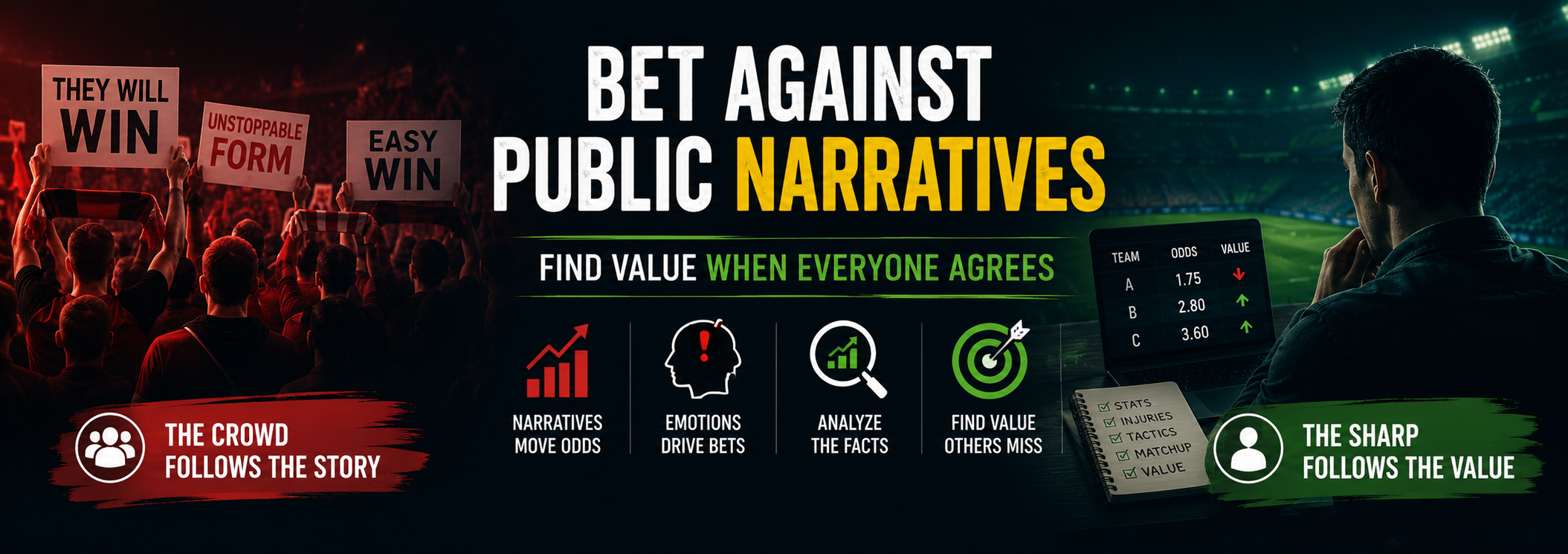
Every weekend, the same stories dominate sports headlines.
"The champions are unstoppable."
"This team can't lose at home."
"The underdogs don't stand a chance."
"The star striker is guaranteed to score."
These narratives spread quickly through television, podcasts, social media, and betting communities. By kickoff, thousands of bettors are repeating the same opinions and placing the same bets. Sometimes those stories turn out to be true. But in betting, being right about the story doesn't always mean you're making a good bet. The question professional bettors ask isn't:
"Who does everyone think will win?"
It's:
"Has the market already priced that belief into the odds?"
That's where the difference between public opinion and betting value begins.
Sports are emotional. Fans don't just support teams—they believe in narratives. A club wins five matches in a row, and suddenly they're "unbeatable." A superstar returns from injury, and expectations soar before they've even played a full match. An underdog shocks a favourite, and everyone starts calling them "the next big thing." As these stories spread, betting money follows. Bookmakers don't ignore this. They know where public money is likely to go, and odds often adjust accordingly. By the time most bettors place their wagers, they're not just betting on a team. They're paying for a story.
Imagine a heavyweight football club coming off three convincing victories. The media praises them. Fans expect another comfortable win. Most bettors back them without hesitation. As money floods the market, their odds shorten from 1.90 to 1.65.
Here's the important question:
Has the team's chance of winning really improved that much? Or has public demand simply pushed the price lower? Even if the favourite wins, backing them at 1.65 instead of 1.90 may no longer represent good value over the long run. The outcome might be correct. The price might not be.
One reason public narratives become so powerful is that people crave certainty. A clear storyline feels safer than uncertainty.
It's much easier to believe:
"This team is in amazing form."
than to consider:
"They've benefited from a favourable schedule, overperformed their underlying numbers, and now face a difficult tactical matchup."
The simpler story almost always attracts more attention. Unfortunately, betting markets reward accurate pricing—not simple stories.
Consensus isn't automatically wrong. Sometimes the obvious favourite really is the best bet. But when nearly everyone shares the same opinion, it's worth asking a few extra questions.
What caused this narrative?
Has anything fundamentally changed?
Is the market reacting to facts—or emotions?
Has the price already adjusted too far?
These questions help separate genuine information from public excitement.
Professional bettors spend less time reading headlines and more time studying context.
Instead of focusing on:
Winning streaks
Viral highlights
Social media hype
They examine:
Injury reports
Tactical matchups
Expected Goals (xG)
Squad rotation
Scheduling advantages
Closing Line Value (CLV)
These factors often reveal a very different picture from the one dominating public discussion. Sometimes the team everyone loves isn't overpriced because they're bad. They're overpriced because everyone already knows they're good.
Some bettors misunderstand this concept. They assume betting against public narratives means automatically backing every underdog. That's just another form of bias. Successful contrarian betting isn't about opposing the crowd for the sake of it. It's about recognising when public opinion has moved the odds beyond fair value. Sometimes the crowd is correct. Sometimes they're not. The key is evaluating the price—not simply choosing the unpopular side.
One reason value betting is psychologically difficult is that it rarely feels comfortable. Backing a team everyone is criticising can feel risky. Ignoring a heavily favoured team during a winning streak can feel strange. But markets don't reward comfort. They reward discipline. The best bets often look unpopular before they look smart.
Financial traders don't buy assets simply because everyone else is buying them. They ask whether the current price still offers value. Sports bettors should think the same way.
Don't ask:
"Who does everyone believe in?"
Ask:
"Has everyone already paid too much for that belief?"
That small change in mindset can dramatically improve long-term decision-making.
Public narratives make sports exciting. They create rivalries, headlines, and unforgettable moments. But they also influence betting markets. The next time everyone agrees on the same outcome, don't rush to follow the crowd.
Pause.
Look beyond the story.
Study the price.
Because in sports betting, the biggest opportunities often appear when everyone else stops asking questions.



Copyright © 2019 SportsTrade.io and all its predictions.
We're concerned about problem gambling. For most people, gambling is entertainment - a fun activity that can be enjoyed without harmful effect. But for some, it's not just a game - it's a serious problem that continues even after the fun has gone.
Compulsive gambling is not easily detected. The person with a gambling problem will often go to great lengths to cover up the problem and will appear to look all right, regardless of the consequences of their gambling.
Warning Signs. Some of the indicators that a person may be suffering from a gambling problem include:
Losing time from work or family due to gambling.
Repeated failed attempts to stop or control gambling.
Borrowing money to gamble or pay gambling debts.
Gambling to escape worry or trouble.
Neglecting the care of one's self or family in order to gamble.
Lying about the amount of time and money spent on gambling.
Gambling more money in an attempt to win back losses.
Selling or pawning personal possessions to get money to gamble.
Feelings of hopelessness, depression, or suicide as a result of gambling.
Remember that help is available. By reaching out to people who understand, you can find the help you need. You can visit the Gambler's Anonymous website here:http://www.gamblersanonymous.org/ or Responsible Gaming Council here: http://www.responsiblegambling.org/
This is a non-profit organization not affiliated with us in any way.
It is an offence for persons under the age of eighteen (18) to make use of the Website. If we are unable to confirm that you are 18 years old then we may suspend your account until such time that we are able to confirm your age. If you are subsequently proven to have been under 18 years of age at the time you made any transactions with us, then:
Your Account will be closed.
All transactions on your account will be made void, and all related funds deposited by you will be returned by the payment method used for the deposit of such funds, wherever practicable.
Sportstrade is committed to providing the best service possible. We want our member to have confidence in our platform, and that's why we offer a Credit Back Guarantee to all tips without profits. This program comes into effect on the 01 July 2015 ('Effective Date') and is offered to ensure that member who made tips purchase of any tips that ended with either lose, draw, cancelled or postponed game. The credits will automatically refund to your account the next day and the information will be available after login in the member dashboard and available in 'transaction history' tab