
Highlight
Successful bettors don't just make better predictions. They make better decisions. That might sound like the same thing, but it isn't.
A prediction answers one question:
"Who do I think will win?"
A decision asks several more:
Is the price fair? Has the market already moved? Are there any missing pieces of information? Does this bet fit my bankroll strategy?
The difference between recreational bettors and disciplined traders often comes down to one simple habit:
They never place a bet without going through a checklist. It may seem unnecessary at first, but a pre-bet checklist can eliminate some of the most common mistakes in sports betting—not by making you smarter, but by making you more consistent.
Every bettor has experienced it. You see odds that look attractive. You remember how well a team played last weekend. A tipster you trust posts the same selection. Within seconds, you've placed the bet.
Only afterwards do you realise:
The team's top scorer isn't starting.
The odds have already dropped significantly.
The market moved before you entered.
You risked more than you normally would.
The problem wasn't your football knowledge. The problem was skipping the process. Good betting isn't just about analysis. It's about avoiding preventable mistakes.
Commercial pilots fly thousands of hours. Experienced surgeons perform the same operations hundreds of times. Yet before every flight and every procedure, they still follow a checklist. Not because they lack experience. Because experience doesn't eliminate human error. Sports betting works the same way. The biggest mistakes rarely happen because you don't understand the sport.
They happen because:
You forgot to check the latest team news.
You rushed into a live bet.
You ignored a major odds movement.
You let emotion override discipline.
A checklist creates consistency when emotions try to take control.
Many bettors imagine complicated spreadsheets and advanced statistical models. In reality, the best checklists are surprisingly simple.
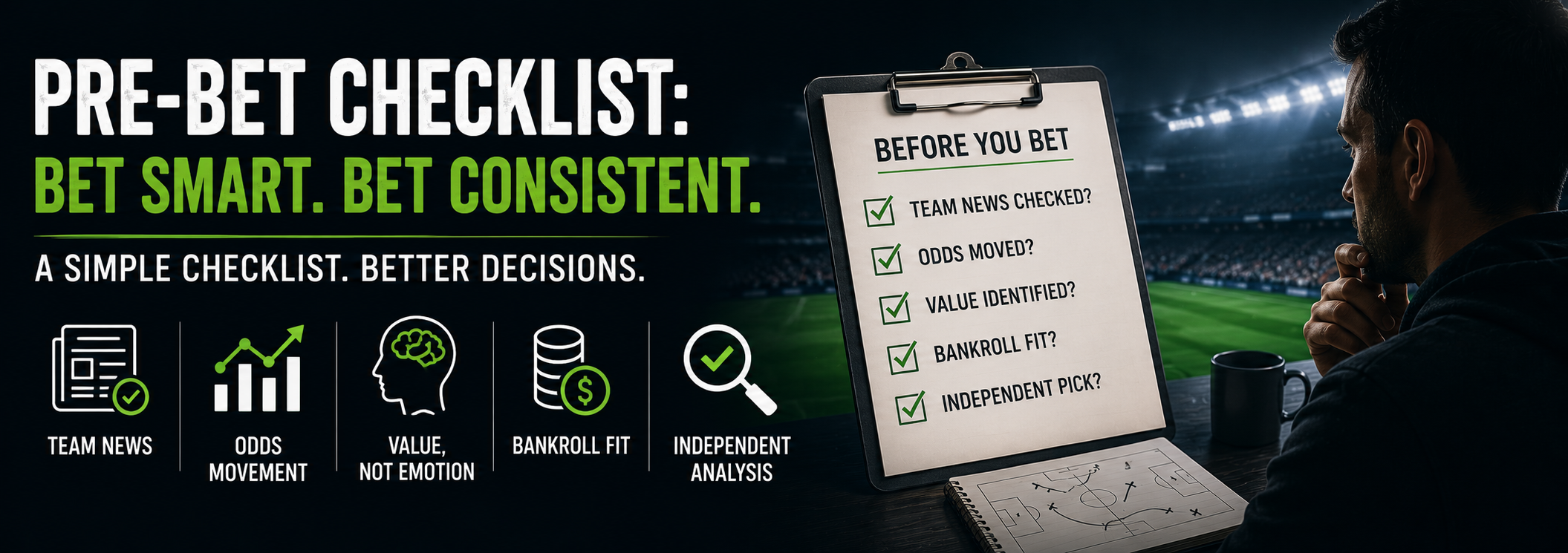
Before placing any bet, ask yourself:
Have I checked the latest team news?
Injuries, suspensions, squad rotation and late lineup changes can dramatically change the value of a bet.
Has the market already moved?
If the odds have shortened significantly, the value that originally existed may already be gone.
Am I betting because of value—or because I want action?
This is one of the most important questions of all. Many poor bets are placed simply because a match is about to start.
Does this bet fit my bankroll plan?
Your confidence should never determine your stake size. Consistency matters far more than emotion.
Would I still place this bet if nobody else recommended it?
This simple question helps separate independent analysis from social influence.
One of the biggest advantages of using a checklist is that it forces you to slow down. Most betting mistakes happen quickly.
You react to:
A social media post.
A winning streak.
A dramatic first half.
Breaking news.
The faster the decision, the greater the chance emotion is involved. A checklist introduces a pause. Sometimes that pause leads to a better bet. Sometimes it leads to no bet at all. Both outcomes can improve your long-term results.
Your first checklist might contain only five questions. Over time, you'll add new ones based on your own mistakes.
Perhaps you'll discover you struggle with:
Chasing losses
Betting on too many leagues
Entering after major line movement
Ignoring weather conditions
Following public hype
Every mistake becomes an opportunity to improve your checklist. Eventually, it becomes your personal decision-making framework.
Many bettors believe success comes from finding better information. Often, it comes from making fewer careless mistakes. Two bettors can analyse the same match. One places the bet immediately. The other spends two minutes working through a checklist. Those two minutes may save hundreds—or even thousands—of dollars over the course of a season.
Professional bettors don't avoid mistakes because they're smarter. They avoid mistakes because they have systems.
There isn't a universal checklist that works for everyone.
A football bettor may prioritise:
Team news
Tactical matchups
Expected Goals (xG)
A tennis bettor might focus on:
Surface type
Player fitness
Head-to-head history
The goal isn't to copy someone else's process. It's to create one that consistently improves your own decisions.
Every bet begins long before you click "Place Bet." It begins with preparation.
A pre-bet checklist won't magically turn losing bets into winners. But it will help you avoid emotional decisions, reduce unnecessary mistakes, and create a disciplined process that stands up over hundreds or even thousands of bets. Because successful betting isn't about making perfect predictions. It's about making consistently good decisions. And every good decision starts with asking the right questions.



Copyright © 2019 SportsTrade.io and all its predictions.
We're concerned about problem gambling. For most people, gambling is entertainment - a fun activity that can be enjoyed without harmful effect. But for some, it's not just a game - it's a serious problem that continues even after the fun has gone.
Compulsive gambling is not easily detected. The person with a gambling problem will often go to great lengths to cover up the problem and will appear to look all right, regardless of the consequences of their gambling.
Warning Signs. Some of the indicators that a person may be suffering from a gambling problem include:
Losing time from work or family due to gambling.
Repeated failed attempts to stop or control gambling.
Borrowing money to gamble or pay gambling debts.
Gambling to escape worry or trouble.
Neglecting the care of one's self or family in order to gamble.
Lying about the amount of time and money spent on gambling.
Gambling more money in an attempt to win back losses.
Selling or pawning personal possessions to get money to gamble.
Feelings of hopelessness, depression, or suicide as a result of gambling.
Remember that help is available. By reaching out to people who understand, you can find the help you need. You can visit the Gambler's Anonymous website here:http://www.gamblersanonymous.org/ or Responsible Gaming Council here: http://www.responsiblegambling.org/
This is a non-profit organization not affiliated with us in any way.
It is an offence for persons under the age of eighteen (18) to make use of the Website. If we are unable to confirm that you are 18 years old then we may suspend your account until such time that we are able to confirm your age. If you are subsequently proven to have been under 18 years of age at the time you made any transactions with us, then:
Your Account will be closed.
All transactions on your account will be made void, and all related funds deposited by you will be returned by the payment method used for the deposit of such funds, wherever practicable.
Sportstrade is committed to providing the best service possible. We want our member to have confidence in our platform, and that's why we offer a Credit Back Guarantee to all tips without profits. This program comes into effect on the 01 July 2015 ('Effective Date') and is offered to ensure that member who made tips purchase of any tips that ended with either lose, draw, cancelled or postponed game. The credits will automatically refund to your account the next day and the information will be available after login in the member dashboard and available in 'transaction history' tab