
Highlight
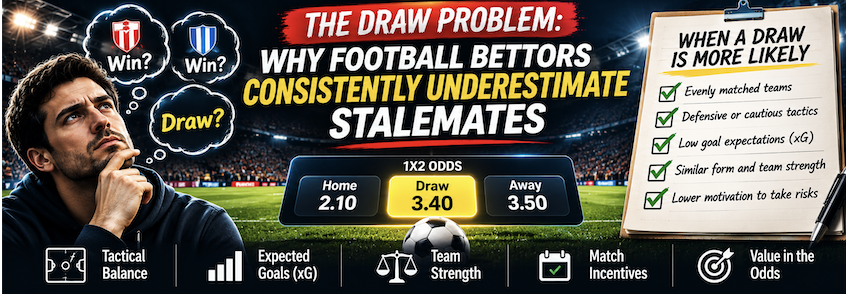
When football bettors analyse a match, the conversation usually revolves around one question: which team will win? Most betting predictions focus on the stronger side, recent form, attacking quality, and whether the favourite can secure three points. But football has a third possible outcome that often receives less attention: the draw.
A 1-1 result rarely generates the same excitement as a dramatic victory, yet draws are an essential part of football betting markets. Bettors who focus too heavily on identifying winners can overlook how frequently evenly matched teams cancel each other out. The challenge isn't simply predicting more draws. It's understanding when the probability of a stalemate is higher than the available odds suggest.
Football betting naturally encourages bettors to choose sides. Supporting the stronger team feels logical, while backing an underdog offers the excitement of a potentially larger payout. A draw, however, can feel like an unsatisfying middle ground. This preference can influence how bettors interpret match information. When one team has better recent form, stronger players or home advantage, bettors may focus on the reasons that team should win while overlooking the possibility that its opponent can prevent defeat.
Consider a match between two defensively organised teams. One may have a slight advantage in attacking quality, but if both struggle to create clear chances, the difference between them might not be enough to produce a winner. The favourite could still be the most likely individual outcome, but that doesn't mean the draw probability is insignificant.
Importantly, bettors shouldn't assume bookmakers systematically underestimate draws. Professional markets account for stalemates, and any potential advantage must come from identifying a specific pricing error rather than simply choosing the less popular outcome.
Some football matches naturally produce more balanced contests than others. Teams that defend compactly, maintain possession without taking excessive risks, or struggle to convert chances may be more likely to remain level. For example, imagine a mid-table team hosting an opponent with similar attacking and defensive statistics. Both managers prefer cautious tactical approaches, and neither side has a strong incentive to take unnecessary risks. In this situation, a draw may deserve more consideration than it would in a match involving two aggressive, high-scoring teams.
However, tactical style alone cannot determine the outcome. A defensive team can concede an early goal, forcing it to attack more aggressively. Likewise, an apparently open match can remain goalless because both teams fail to convert their opportunities. The objective is to understand how playing styles influence the distribution of possible results rather than assume defensive football automatically produces draws.
Expected Goals (xG) and goal-scoring models can help bettors assess draw probabilities, particularly when both teams have similar attacking expectations. Consider two hypothetical matches. In Match A, the home team is expected to score 2.1 goals while the away team is expected to score 0.7. In Match B, both teams are expected to score approximately 0.9 goals. Under a simple independent Poisson goal model, Match B would have a substantially higher draw probability because the teams have similar scoring expectations and the projected total is relatively low.
This illustrates an important relationship: draw probabilities are influenced by both the balance between teams and the expected number of goals. A low-scoring match between evenly matched teams often has a greater probability of finishing level than a high-scoring match between teams of similar strength. Of course, statistical models have limitations. Red cards, tactical adjustments, player availability and match circumstances can all affect the actual distribution of results.
Even if a match appears likely to finish level, that doesn't automatically make the draw a good bet. Suppose your analysis estimates a 30% probability of a draw. That corresponds to fair decimal odds of approximately 3.33. If a bookmaker offers 3.60, the price may represent positive expected value, assuming your probability estimate is accurate. If the market offers only 3.00, the same prediction would be unattractive. This is why bettors should avoid treating draws as a special category where the normal rules of value betting no longer apply.
A draw at 4.00 isn't automatically attractive because the payout is relatively high. Similarly, a draw at 2.80 isn't necessarily poor value if the underlying probability genuinely justifies the price. The important factor is always the relationship between estimated probability and available odds.
Many football tipsters build their reputations around identifying winning teams. Their analysis may focus heavily on form, league position, injuries and tactical advantages, with less discussion of whether those advantages are large enough to produce victory. This can create a gap between predicting the stronger team and evaluating the complete 1X2 market.
A tipster might correctly identify that the home team is stronger but still underestimate the probability of a draw. If the favourite's odds are too short, backing it may offer poor value despite the underlying analysis being reasonable. For followers, this highlights the importance of evaluating all three possible outcomes rather than automatically accepting the recommended side. It also explains why Asian Handicap and Draw No Bet markets can be useful alternatives in certain situations. These markets change the financial consequences of a draw, although their prices and settlement rules must be assessed independently.
Draws may not be the most exciting outcomes in football, but ignoring them can lead to incomplete probability assessments and poor betting decisions. Understanding tactical balance, expected goals, team strength and match incentives can help bettors estimate when stalemates are more plausible. However, identifying a likely draw is only the first step. The available odds must still justify the risk. The objective isn't to start betting draws more frequently. It's to stop treating them as an afterthought.
In football betting, finding the most likely winner is only part of the analysis. Sometimes the most important question is whether either team is likely to win at all.



Copyright © 2019 SportsTrade.io and all its predictions.
We're concerned about problem gambling. For most people, gambling is entertainment - a fun activity that can be enjoyed without harmful effect. But for some, it's not just a game - it's a serious problem that continues even after the fun has gone.
Compulsive gambling is not easily detected. The person with a gambling problem will often go to great lengths to cover up the problem and will appear to look all right, regardless of the consequences of their gambling.
Warning Signs. Some of the indicators that a person may be suffering from a gambling problem include:
Losing time from work or family due to gambling.
Repeated failed attempts to stop or control gambling.
Borrowing money to gamble or pay gambling debts.
Gambling to escape worry or trouble.
Neglecting the care of one's self or family in order to gamble.
Lying about the amount of time and money spent on gambling.
Gambling more money in an attempt to win back losses.
Selling or pawning personal possessions to get money to gamble.
Feelings of hopelessness, depression, or suicide as a result of gambling.
Remember that help is available. By reaching out to people who understand, you can find the help you need. You can visit the Gambler's Anonymous website here:http://www.gamblersanonymous.org/ or Responsible Gaming Council here: http://www.responsiblegambling.org/
This is a non-profit organization not affiliated with us in any way.
It is an offence for persons under the age of eighteen (18) to make use of the Website. If we are unable to confirm that you are 18 years old then we may suspend your account until such time that we are able to confirm your age. If you are subsequently proven to have been under 18 years of age at the time you made any transactions with us, then:
Your Account will be closed.
All transactions on your account will be made void, and all related funds deposited by you will be returned by the payment method used for the deposit of such funds, wherever practicable.
Sportstrade is committed to providing the best service possible. We want our member to have confidence in our platform, and that's why we offer a Credit Back Guarantee to all tips without profits. This program comes into effect on the 01 July 2015 ('Effective Date') and is offered to ensure that member who made tips purchase of any tips that ended with either lose, draw, cancelled or postponed game. The credits will automatically refund to your account the next day and the information will be available after login in the member dashboard and available in 'transaction history' tab